THE BBC YOUTUBE OPPORTUNITY MADE CLEAR
The BBC's Deepwatch and Showground YouTube briefs, explained. What they require and what they reveal about developing formats platform-first

TL;DR
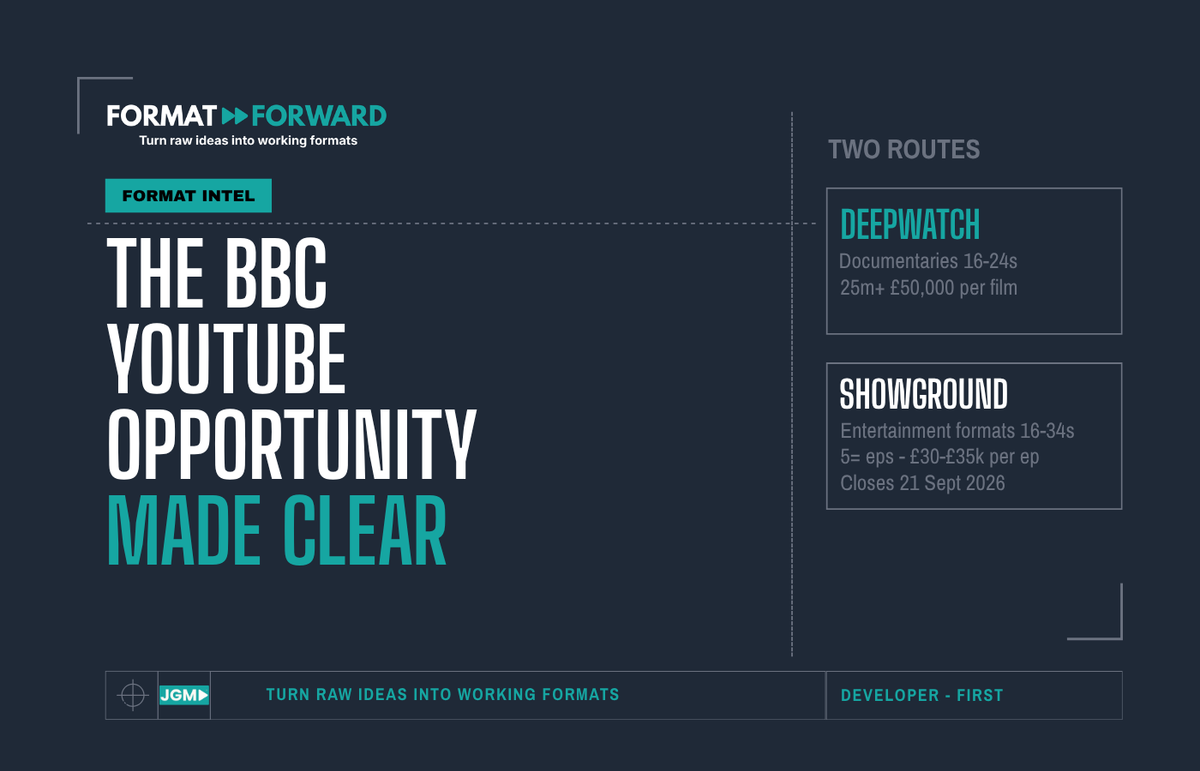
- The BBC's new YouTube strategy has two live commissioning routes: deepwatch (documentaries, 16–24s) and Showground (entertainment formats, 16–34s).
- Neither requires a recent broadcast commission. Both require partnering with an eligible production company if you're an independent creator.
- The real value of these briefs isn't just who can apply, it's what the BBC has revealed about developing content for a platform where the audience chooses everything.
- The core shift: the question is no longer just "is this a good programme?" It's "why would somebody choose it, stay, and come back?"
The BBC YouTube Opportunity, Made Clear
There are two routes into the BBC's new YouTube commissioning strategy. But even if you never pitch, the briefs are worth reading.
Since the BBC published its YouTube commissioning briefs, there has been quite a lot of misinformation on social media about what they actually say, who can apply and what experience you need. So I thought I would do my best to strip away the noise and find out the facts.
The story begins with the strategic partnership announced by the BBC and YouTube in January 2026. This was not simply an agreement to put more existing BBC programmes onto YouTube. The BBC said the partnership would include investment in new YouTube-first programming, alongside creator training and development, while continuing to launch new material on BBC-owned services including iPlayer and Sounds.[1]
That is quite an important change of emphasis.
The BBC is no longer simply asking how television programmes can live on YouTube. It is beginning to ask what it should commission if YouTube is the starting point.
And because the BBC has made quite a lot of its commissioning thinking public, we can now see what that means in practice.
The first route is deepwatch
The BBC's current rolling YouTube commissioning priority is deepwatch, a documentary destination aimed at 16 to 24-year-olds. The brief is for standalone documentaries of at least 25 minutes, with an indicative production and delivery tariff of £50,000 per film. The subject areas range from online culture to hidden systems and underworlds, alongside stories about the experience of growing up in modern Britain.[2]
What is more revealing than the subject matter, though, is the way the BBC asks producers to think about the pitch. It is not enough to explain why a story matters. Producers are asked to explain why a 16 to 24-year-old would choose to watch it specifically on YouTube, and that requirement pulls the platform into the development process from the beginning.
The pitch is expected to include the central story, the anticipated payoff, the presenter or creator, the access, a proposed YouTube title and an example thumbnail. That is a significant shift in emphasis because the title and thumbnail are no longer treated as promotional materials that get added after the programme has been developed. They form part of the idea itself.
The BBC's wider YouTube guidance reinforces that approach. It talks about the title and thumbnail working together to "earn the click", and then about the opening of the programme quickly validating the promise that persuaded the viewer to click in the first place. From there, the content has to keep justifying the audience's attention through visible progress, a clear central question and a satisfying payoff.[2]
That is a very different starting point from traditional scheduling, where the programme could assume a degree of audience inheritance from the slot, the channel or the presenter. On YouTube, none of that can be taken for granted.
There is also an attempt to open the route beyond established BBC suppliers. Companies pitching directly still need relevant digital-first and factual production experience, along with the ability to meet BBC standards around compliance, duty of care, editorial responsibility and delivery. But individual creators and digital producers who cannot meet those requirements alone can partner with an established production company that can.[2]
So deepwatch is already trying to bridge two production cultures. It wants the instincts of digital creators, but it also wants the infrastructure and accountability of professional production.
Then there is Showground
The second route, BBC Showground, is much more obviously about entertainment formats. The BBC published the brief on 27 August, and it is aimed primarily at 16 to 34-year-olds. Applications close on 21 September 2026.[3]
The structure is effectively a paid development process. Around six companies are expected to receive £5,000 each to develop at least one returning format, after which the BBC expects to commission at least three companies to make formats of five or more episodes. Episodes should run for more than 15 minutes, with an indicative production cost of £30,000 to £35,000 each.[3]
This is the part of the opportunity where some of the debate about eligibility has become confused. I have seen the suggestion that applicants need to have received a broadcast commission within the previous year. That is not what the brief says.
The actual wording requires applicants to demonstrate at least one relevant returning entertainment format aimed at 16 to 34-year-olds that has been published within the previous 12 months.[3]
That distinction matters because "published" is not the same as "broadcast commissioned". In fact, the BBC then goes on to ask for experience designing mid-to-long-form content for YouTube or another major digital platform, including SVOD services. It also wants evidence that the work reached its intended audience and that the applicant has experience making multi-episode content rather than one-off videos or promotional pieces.[3]
So this is not a case of the BBC insisting that television experience should outrank digital experience. The brief is clearly looking for evidence of digital production and audience understanding.
There is, however, still a meaningful barrier to entry. Applicants need the production management, compliance, health and safety, contributor care and business affairs capabilities required to deliver a BBC commission. Individual creators, sole traders and informal production teams cannot apply completely independently. They need to partner with an eligible production company that can act as the lead applicant.[3]
That is where the more interesting criticism sits. The BBC wants creator-led, digital-native ideas, but it also wants someone in the relationship who can carry the industrial responsibilities of a BBC production.
You can argue that this narrows access for genuinely independent creators. But that is a different argument from saying the BBC demands recent broadcast experience.
The real position is more nuanced. The BBC is saying that it wants digital-native creativity, but it still expects professional production accountability around it.
We have always been a little too fond of labels
We work in an industry that has always been slightly obsessed with labels.
I remember being very keen, as a director, to move into situation comedy. At the time I was known mainly for music, quiz and entertainment shows, and crossing into another genre was treated as such a significant step that I effectively had to re-interview for the opportunity.
Of course, different genres do require different skills. Working with talent is a skill in itself. But by then I had already directed Warren Mitchell, worked with Johnny Speight, worked with some of the biggest presenters of the day and dealt with more than a few substantial celebrity egos and their managers, from Cher to Celine Dion to Julio Iglesias. Julio, incidentally, had one very specific request: no shots from his left.
Entertainment directing was never simply about cutting cameras and understanding the technical side of a studio. A large part of the job was always about people, performance, tone and communication.
That experience probably explains why I have always been slightly resistant to labels.
Just because somebody comes from television does not mean they should be excluded from the digital world, and the reverse is equally true. The platforms are different, the audience behaviour is different and some of the production grammar is different, but the borders are nowhere near as rigid as we sometimes pretend.
There was a lovely example of this in one of Louis Theroux's programmes about influencers. He was talking to people who were used to addressing their audiences online and they kept looking directly into the camera. Theroux wanted them to ignore it and talk to him, which is completely natural within the traditional fly-on-the-wall language of television documentary. But to the influencers, looking into the lens was equally natural. That was how they communicated with their audience.
I made a similar choice when we made Good Game Asia. For the main interviews with the contestants, I had them look straight down the camera rather than slightly off lens towards a producer, as television interviews have traditionally done.
Why? Because that is how online audiences are used to being spoken to. The contributor is not apparently talking to somebody standing beside the camera. They are talking directly to you. It feels more personal, more immediate and more like a one-to-one conversation.
That does not mean one approach is right and the other is wrong. It means the grammar changes with the medium.
And that, for me, is the more useful way to think about the BBC's YouTube opportunity. We should be wary of turning "television people" and "digital people" into opposing tribes. Good producers and directors understand different forms, learn the conventions of the platform they are working on and then communicate those choices clearly to everyone making the programme.
Whether the final result appears on television, YouTube or somewhere we have not invented yet, that part of the job has not really changed.
But the most useful part may have nothing to do with applying
This is where I think both briefs become much more interesting.
Forget for a moment whether your company qualifies. Forget even whether you have any intention of pitching the BBC. Read them as development documents.
Because the BBC has effectively published a useful guide to some of the questions anybody developing content for YouTube should probably now be asking.
The starting point is no longer simply, "What is the programme?"
It is also, "Why would somebody choose it?"
That distinction matters because the audience is no longer passively encountering a show in a schedule. They are seeing a title, a thumbnail, perhaps a familiar face, and dozens of competing options sitting around it.
The programme has to earn the click before it can earn the viewer's attention. And once somebody has clicked, the content has to prove almost immediately that the promise which brought them there was worth following.
That is why the BBC's emphasis on packaging is more significant than it might first appear. The title and thumbnail are not simply marketing devices. They are part of the proposition itself.
If they oversell the programme, the viewer feels misled. If they undersell it, nobody clicks. If the opening of the programme does not quickly deliver on what was promised, the audience can leave without a second thought.
Traditional television development has often concentrated heavily on the programme itself. What is the premise? Who presents it? What happens in each episode? What is the structure?
Those questions still matter.
But in a platform-first environment they are no longer enough.
The mechanics of discovery start to become part of the creative process.
Showground takes that thinking into format development
For anyone interested in entertainment formats, the Showground brief is particularly useful because it takes those platform ideas and applies them directly to format construction.
The BBC wants what it calls a clear format engine. In other words, there should be a simple rule, ritual, task or mission capable of repeatedly generating entertainment. The idea has to be bigger than the particular people appearing in one episode, so different combinations of talent can enter the format while the central mechanism remains recognisable.[3]
That is, of course, one of the fundamental principles of format development. But in a YouTube environment, the value of that clarity becomes even greater because the central idea also has to be understood quickly.
The BBC also wants each format to have a signature. That might be a repeated question, an entrance, a challenge, a prop, a reveal or some other device the audience learns to recognise and anticipate. It wants the format to reveal character rather than simply give personalities somewhere to talk, and it wants viewers to feel they are participating in the experience, predicting outcomes, recognising running jokes and gradually becoming part of a community around the programme.[3]
The examples in the brief tell us quite a lot about the thinking. The BBC points to Chicken Shop Date, Hot Ones Versus, Game Changer, Make Some Noise, Keep the Meter Running and Recess Therapy.
It is careful to say it does not want copies. What those shows share, though, is something more fundamental. Each has a simple proposition, a recognisable ritual and a very clear relationship between the format and the people taking part.
You understand the world of the programme very quickly.
And that matters enormously when discovery begins with a thumbnail rather than a schedule.
The sentence traditional television producers should probably read twice
The Showground brief also says explicitly what the BBC does not want. It does not want television programmes made smaller or shorter for YouTube, and it does not want conventional panel shows, game shows or factual entertainment formats where digital talent has simply been inserted into an otherwise familiar television structure.[3]
That strikes me as one of the most significant parts of the whole exercise.
Putting something on YouTube does not make it a YouTube format. Hiring a creator does not make it creator-first. Making an episode shorter does not make it digital.
The underlying idea has to understand the behaviour of the audience and the environment in which they encounter it.
That has implications much further upstream in development. The central proposition needs to be immediately understandable. It helps if there is a ritual, challenge, question or repeated piece of behaviour that can be recognised quickly. Character should emerge through what people do inside the format rather than simply through conversation, and the structure needs enough progression that the audience always feels there is a reason to stay for the next beat.
None of this means television craft suddenly stops mattering.
If anything, good structure, casting, storytelling, performance and payoff become more important because the viewer can leave at any moment.
What changes is the assumption that the viewer is already there.
Which is why I think these briefs matter beyond the BBC
There are perfectly legitimate questions about the commissioning structure. The BBC wants to work with a new generation of digital creators while retaining many of the protections, processes and responsibilities of the established television production system. That will inevitably make access easier for some companies than others.
But I would not allow that argument to obscure what is actually useful here.
The BBC has put a surprising amount of its platform-first development thinking into the public domain. Read together, the deepwatch and Showground briefs amount to something close to a working philosophy for developing content in an environment where the audience chooses every programme rather than simply encountering it in a schedule.
That changes the starting point.
In traditional television development, the conversation has often begun with the programme itself. What is the format? Who presents it? What happens in an episode? What is the structure?
Those questions still matter, but on YouTube they are no longer enough.
The viewer has to make a decision before any of that matters.
They see a title, an image, perhaps a familiar face, and a screen full of alternatives. The programme has to earn the click before it can earn the viewer's attention. Once it has done that, it has to demonstrate very quickly that the promise made by the title and thumbnail was worth following.
That is why the BBC's emphasis on packaging is more interesting than it might first appear.
The title and thumbnail are not simply promotional devices. They are part of the proposition itself. If they exaggerate the idea, the content disappoints. If they undersell it, nobody clicks. If they promise one thing and the opening delivers another, the audience leaves.
For a format creator, that has consequences much further upstream.
It means the central engine of an idea has to be immediately understandable. It helps if there is a recognisable ritual, challenge, question or piece of behaviour that can be communicated in a sentence and understood in an image. It means character should emerge through what people do inside the format rather than simply through conversation. And it means the programme needs enough progression that the audience feels there is always a reason to watch the next beat.
None of this means television craft suddenly stops mattering. If anything, good structure, casting, storytelling, performance and payoff become more important because the audience can leave at any moment.
What changes is the assumption that the viewer is already there.
That may be the most useful lesson in these briefs.
The BBC is not simply moving programmes from one distribution system to another. It is beginning to acknowledge that the mechanics of discovery and consumption have become part of the creative process itself.
And that is worth paying attention to whether you ever intend to pitch the BBC or not.
Because the real question is no longer simply, "Is this a good programme?"
It is also, "Why would somebody choose it, why would they stay, and why would they come back?"
That feels like a much more useful way to think about developing formats for the next phase of television, wherever they eventually appear.
Sources
1. BBC Group and YouTube strategic partnership, 22 January 2026.
The partnership announced investment in fresh YouTube-first programming, creator development and training, alongside continued distribution through BBC-owned services.
2. BBC Content, "YouTube commissioning" and BBC deepwatch commissioning brief.
The rolling commissioning guidance sets out the BBC's platform-first approach, including audience targeting, title and thumbnail development, click motivation, viewer retention, payoff and deepwatch eligibility requirements.
3. BBC Content, "Commissioning opportunity: YouTube entertainment – BBC Showground (w/t)", published 27 August 2026.
The brief sets out the eligibility requirements, paid development process, tariffs, format criteria, creative reference points and the BBC's list of what it does and does not want.
I'm dyslexic, AI helps me make this readable. The thoughts and opinions are my own. There are no auto-generated articles, I read and research with rigour.