OUTSIDE, Netflix: Who Can Afford to Prove a Format?
The Sidemen turned a self-funded YouTube experiment into a Netflix franchise. A teardown of the game, the route to commission, and whether comic spending carries real stakes.

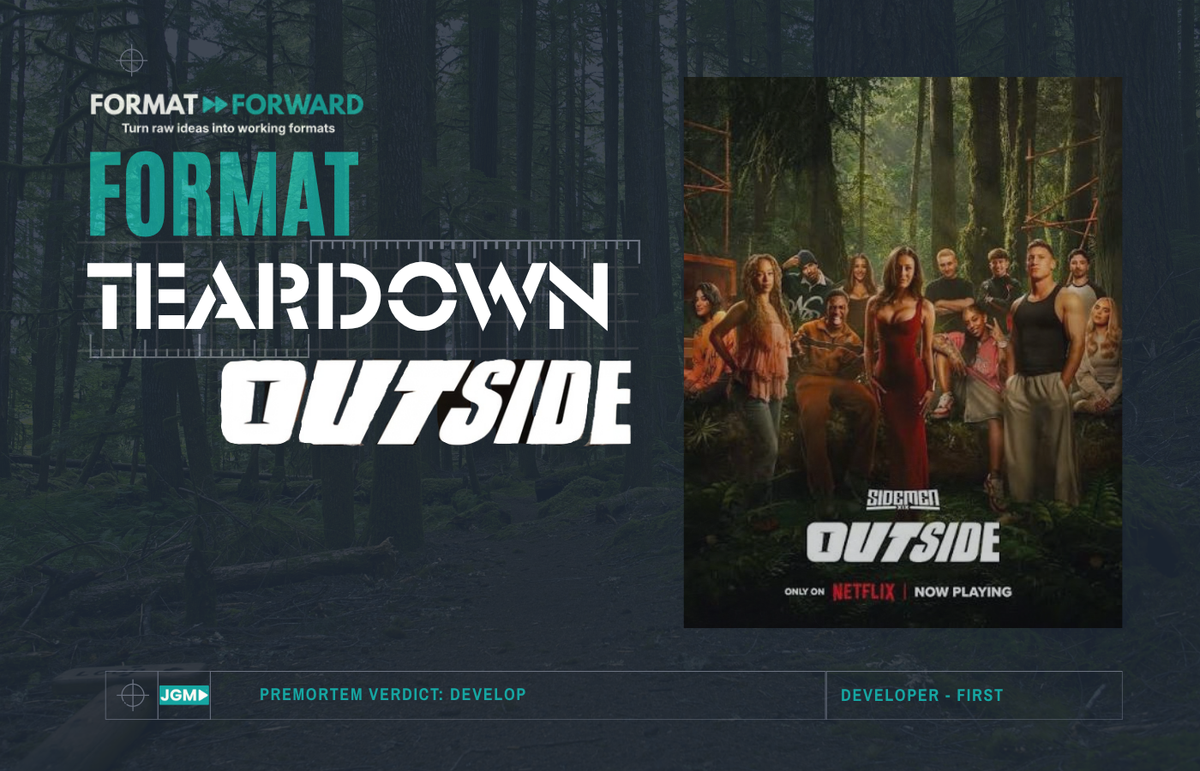
The Sidemen turned a self-funded YouTube experiment into a Netflix franchise. A teardown of the game, the route to commission, and whether comic spending carries real stakes
By Jonathan Glazier | Format Forward | Format Lab
Format Teardown
In my teardown of The Box I looked at one kind of insurance commissioners now want before they commit: a track record in another territory. Outside shows a different kind. The Sidemen didn't pitch Inside to anyone. They paid for it, made it, put it out on their own channels, and arrived at Netflix with a finished show and an audience already watching. That's proof over pitch at its most powerful. It also raises an awkward question for everyone else in development: who can afford to generate that proof? And underneath the business story sits a format question I'd want answered before a third series: when a contestant spends the prize money on comfort, what do they actually stand to lose?
The Proposition
Outside places twelve creators and entertainment personalities in a forest with a potential £1 million prize. Challenges and temptations put them under pressure. Comfort purchases reduce the pot, while alliances and eliminations shape the competition. The Sidemen bring their comic identity and step in to stir things up. Netflix's own description makes the bargain clear: comfort eats into the money.
My first reaction was that I recognised the machinery. Put people somewhere uncomfortable, offer them relief, make that relief cost money from a shared fund, and let everyone argue about the bill. That's a good reality proposition because it hands viewers something to judge straight away. Would I spend? Is that person being selfish? Is a decent night's sleep worth the price? Why should someone who refuses every temptation subsidise someone who takes them all?
Those questions carry a programme because they connect to life outside television. We all know the person who orders more when everyone has agreed to split the bill.
The machinery also has a clear antecedent. Channel 4 announced Tempting Fortune in May 2022: strangers in the wilderness with basic supplies, surrounded by expensive comforts, with every indulgence deducted from the shared prize. It reached viewers in 2023, before Inside launched on YouTube in 2024. Paddy McGuinness hosted the first two series, Rob Beckett the third.
That's a close structural match, and it supports my view that Outside is derivative in its cost-of-comfort mechanism. It doesn't prove copying, and it doesn't tell us how the Sidemen developed their idea. Familiar ingredients can still make strong television. The test is what this combination makes people do, and why we keep watching.
In Pre-Mortem terms, the title raises a Shared Script question. Outside is a neat extension of Inside, and existing fans get the joke instantly. A viewer who doesn't know the franchise needs the explanation before they understand the promise. That's fine for a franchise extension. But it matters when you ask how much appeal the format has on its own.
My take is that the real selling point is the cultural package: a creator brand speaking in a voice younger creator audiences already know. "For Gen Z, by Gen Z" captures the positioning, even if it can't describe every viewer or every member of the team. The mechanism itself offers much less that's new.
The Evidence Route
The route to commission deserves real credit, and it starts with Inside.
According to Sidemen manager Jordan Schwarzenberger, the group commissioned that show themselves in January 2024, developed it over the following months and started production with Cowshed Collective in May. They committed a seven-figure sum of their own money. Inside launched on their YouTube channels in June. Netflix approached in July, negotiations ran through the following months, and a global two-season deal landed in November. The second UK series reached Netflix in March 2025.
In his TellyCast interview, Victor Bengtsson describes the original brief as "Big Brother for Gen Z". He reports 30 days of pre-production, seven days filming and nine days editing, followed by 55 million views in ten days. Those are the producer's own figures, and they're aggregate views, not unique viewers or a TV audience measurement. But they show the scale of demand the team could point to.
That sequence changes the relationship between producer and buyer. By the time Netflix entered the conversation, it could assess a finished programme, the team's execution, and how the concept performed across the Sidemen's own distribution. We don't know which metrics Netflix looked at or how it weighted them. But making and releasing the show generated the evidence for its next buyer.
Evidence still needs reading. A YouTube following doesn't guarantee viewers will follow a show onto a subscription service, finish a series or come back for another. What it does is give a commissioner something concrete to investigate, with most of the development and production risk already absorbed by someone else.
Who Can Afford The Proof?
That's where the cheerful advice to "make it yourself and prove it works" needs scrutiny.
Most independent producers can't fund a seven-figure series before they have a buyer. Fewer still have a ready-made channel that can put millions of people in front of the experiment. Production capital and distribution both count here, and the Sidemen had both. Their achievement deserves credit, but it shouldn't become an argument that everyone else simply lacks ambition. If buyers increasingly favour demonstrated demand, access to the money that generates the evidence becomes a competitive advantage in itself.
My reading is that the competitive field now has another powerful group in it. Alongside broadcasters and production companies sit the most successful, cash-rich creator businesses, able to finance programmes, distribute them, and walk into streamer negotiations with audience data. Broadcasters buy and distribute. Production companies develop and supply. Creators increasingly do several of those jobs at once, and they compete for attention, talent, IP and commissioning money.
The group has since set up Sidemen Productions, with Bengtsson as CEO and Adam Cohen heading the production company. Netflix and Sidemen Productions announced Outside at Edinburgh on 26 August 2026, ahead of its September launch. Trade coverage credits Gareth Birkett as director, with Bengtsson, Cohen, Jack Richardson and the Sidemen as executive producers. Cowshed's involvement in Inside shouldn't be assumed as an Outside credit.
For a smaller format developer, that changes the question. Who can help you test an idea at a credible scale? A creator partnership might be one answer. But the parties still need to agree who funds the risk, who owns the format and who benefits from a commission. The opportunity is real. So is the imbalance in who can afford to chase it.
And there's a commercial question underneath. How much value sits in a repeatable game another cast could play, and how much depends on these creators and their community? Global availability on Netflix doesn't answer that, and it doesn't tell us whether local versions can be licensed. That needs the rights position and the production economics.
Where It Could Break: The Cost Of Comfort
The part I'd put under the most pressure in development is the spending.
The format asks us to care about protecting the money. Its comedy can encourage us to enjoy the people who spend it. That tension could be productive. The reckless contestant becomes the funniest person in the show, while the sensible one becomes the obstacle to everyone's fun.
The danger comes if spending carries too little personal consequence. If I can buy comfort, create a memorable moment and leave everyone else to absorb the cost, what have I actually risked? The pot falls, but have my own chances changed in a way the audience can follow?
This is a Format Engine question, and the Pre-Mortem's central finding comes down to one line: does the pleasure of watching someone spend depend on believing they could lose something that matters to them?
A big number on screen can't supply that belief by itself. Viewers need to understand how purchases connect to relationships, elimination and who eventually gets the prize. The balance tells us how much money exists. It doesn't tell us who holds power, who's in danger or who deserves to win.
Three Viewers, Three Exits
The Audience Reality check complicates things further. Three younger, solo-viewing perspectives each raised a different question. One wanted a moral dilemma that could stand up to scrutiny. Another wanted easy entertainment without having to track every alliance. A third wanted to see why the outcome was fair.
All three could enjoy the same show. They wouldn't necessarily leave for the same reason. "Young creator fans" tells a producer too little about what the edit has to deliver.
That's why the early reaction interests me. In the Reddit discussions I looked at, some viewers praised the production and casting while others wanted more time on the challenges. A longer thread questioned the strategic depth and asked for more relationship-building.
That points at something worth testing: have we seen enough of the relationships to care when a purchase damages one? An argument means more when we understand what existed before it. Faster storytelling can cut the very material that gives a confrontation its weight.
The same goes for clips. A purchase, an insult or an outrageous temptation can make a complete little piece of entertainment on its own. If the clip delivers the setup and the payoff, what's left to pull that viewer into the episode?
Blunder: When The Cast Is Also The Broadcaster
Outcome-driven reality has always lived with the risk of a leak. Outside may have just shown how much bigger that risk gets when the cast are creators with their own live channels.
According to The Sun, contestant Lacy was livestreaming from an amusement arcade with fellow contestant TheBurntChip when Chip's girlfriend, Sabina, walked up and asked Lacy, "When do you get the money then?" Lacy looked stunned and covered his face. Chip steered Sabina out of shot, then came back and tried to suggest the question was about something else. The clip went round TikTok.
We don't know what she meant, and I'm not treating it as proof of anything. But that hardly matters. Once viewers think they know who leaves with the money, the format's central tension starts to drain away. Every spending decision gets watched through the lens of the result, and the question "will they keep hold of the cash?" becomes "how did the winner get there?" That's a much weaker reason to keep watching.
This is the flip side of the evidence route. The same creator distribution that proved demand for Inside also means twelve people, and everyone around them, are broadcasting live to millions of followers while the series is still unfolding. A traditional cast goes quiet until transmission. A creator cast goes live tomorrow. Their friends and partners are on camera too, and they haven't signed anything.
For anyone developing a creator-led format with a money outcome, that's a production design question, not just a legal one. NDAs cover the cast. They don't cover a girlfriend in an arcade. The safer answer may sit in the format itself: shoot closer to transmission, hold back how the money is finally shared out, or build in a late twist so that knowing the prize isn't the same as knowing the ending.
Improvements
Pre-Mortem verdict: Develop. The core dilemma gives viewers a clear reason to take sides, and the Sidemen bring an audience relationship most producers would pay for. Three things need tightening.
First, make the link between spending and competitive consequence unmistakable. That doesn't mean punishing every indulgence or turning the show into an exercise in thrift. Spending could buy an advantage, damage trust or shift someone's position. Whatever the mechanism, the player should understand the choice beforehand and own the consequences afterwards, and the audience needs enough information to judge it too. Before proposing anything new, I'd map the existing game and check whether the episodes already make those consequences clear.
Second, cut clips that leave a meaningful consequence unresolved. Let the audience meet the programme through the joke, and come back to find out what it changes.
Third, test the appeal with and without the Sidemen name. Both versions may have value, but the answer tells you how much belongs to the game and how much belongs to this cast, voice and community. For anyone thinking about the format's international life, that's the number that matters.
Outside brings two development questions together. Can the game make its pleasures build into something larger? And how does an independent producer compete when powerful creators can finance the evidence that wins a commission? The Sidemen showed the advantage of arriving with a programme and an audience already in place. The next test is what the programme gives those viewers a reason to keep watching. Each purchase should change more than a graphic. It should change what someone stands to lose, who trusts them, or what they have to do next.
That's when the cost of comfort becomes a story worth coming back to.
This is the kind of question a Pre-Mortem is built to put under pressure before the cameras roll. If you're developing a format where a central temptation carries the show, and you want to know whether the stakes land with a cold audience, or whether the value sits in your game or your talent, that's what the Premortem service does. Work with me.
I am dyslexic. AI helps me make this readable. The thoughts and opinions are my own. There are no auto generated articles and I read and research with rigour.
Jonathan Glazier
Format creator and executive producer, altmedia
TV format consultant and former BBC Head of Light Entertainment and International Formats