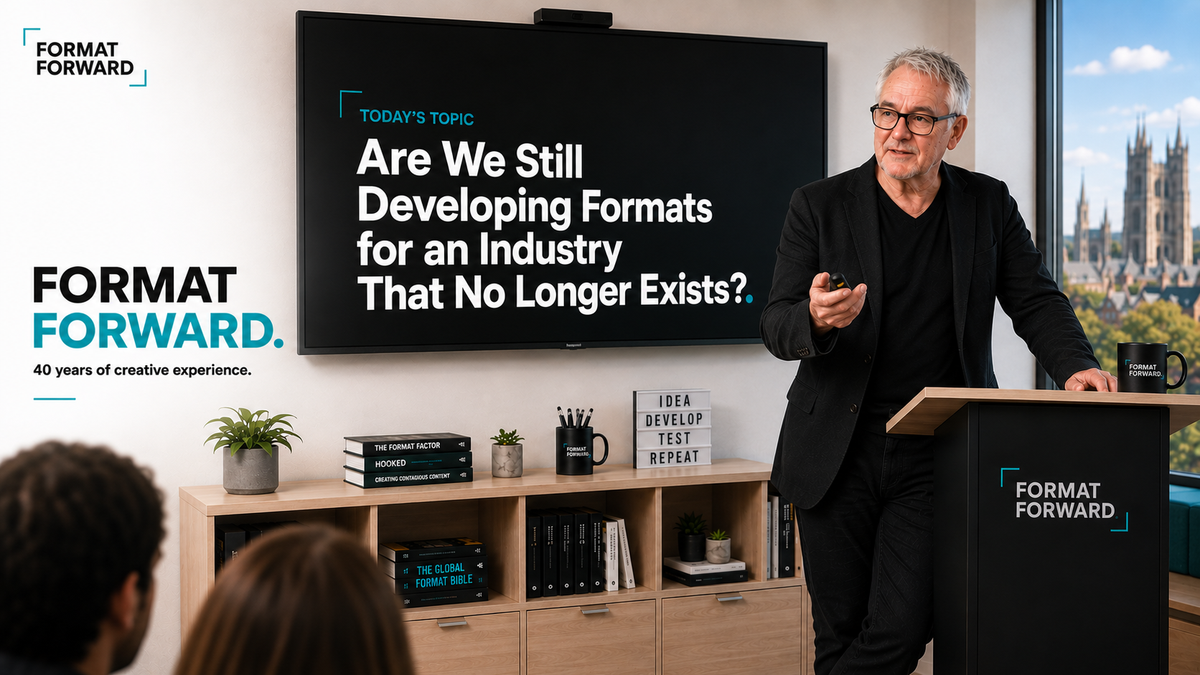
Are We Still Developing Formats for an Industry That No Longer Exists?

There is a quiet problem in unscripted development.
We talk about new ideas, new platforms, new buyers, new technology and new audience behaviour. Then we often develop as if the old system still controls everything. The old system had a familiar shape. You found an idea, shaped it into a television proposition, imagined the channel, built the deck, pitched the commissioner and waited for permission to make it real.
That route still exists. It still matters. It still pays for a lot of television. But it no longer describes the whole market. And that is where the danger sits. Because if we develop every format as if its natural destination is a broadcaster slot, we may be designing for a shrinking version of the opportunity.
The audience has moved. The money has fragmented. The platforms have multiplied. Talent can build direct relationships with viewers. Brands can fund their own entertainment. Creators can test mechanics in public. Clips can travel further than episodes. Communities can become more valuable than schedules. A format can begin before a commissioner ever sees it.
Yet much of development still starts with the same old reflex.
What channel is it for?
Who would commission it?
Where does it sit in the schedule?
Those are not bad questions.
They are just not always the first questions anymore. The better question may be:
What kind of audience behaviour does this idea create?
Because that is where the real shift has happened. A format used to prove itself when a buyer said yes. Now, in many cases, a format may need to prove itself before the buyer arrives. It may need to show that people understand it quickly, share it instinctively, return to it willingly, and recognise the pattern without needing the whole machinery of television around it.
That does not make traditional television irrelevant.
It makes format thinking more important.
If anything, the craft has become harder.
A premise is easy to generate. AI has made that even easier. But a repeatable audience system is different. It needs a clear promise. It needs mechanics. It needs pressure. It needs progression. It needs casting logic. It needs variation. It needs a reason to return. And increasingly, it needs to live in more than one place. That is why I think we need to be honest about the development habit we inherited.
We were trained to get ideas commissioned.
The market now asks us to understand how ideas live. Those are connected, but they are not the same thing. A commission can make a programme. But repeatability, ownership, audience behaviour and adaptability create format value.
So perhaps the question is not simply, “Who will buy this?”
Perhaps the better question is:
If no one bought this tomorrow, would the idea still know how to find an audience? That may be an uncomfortable test. But it might be the test that tells us whether we are developing a programme for the old market, or a format for the one we are actually in.