What is a Format NOW?
We need to talk about what a "format" is now, in this changed world of making stuff for people to watch.

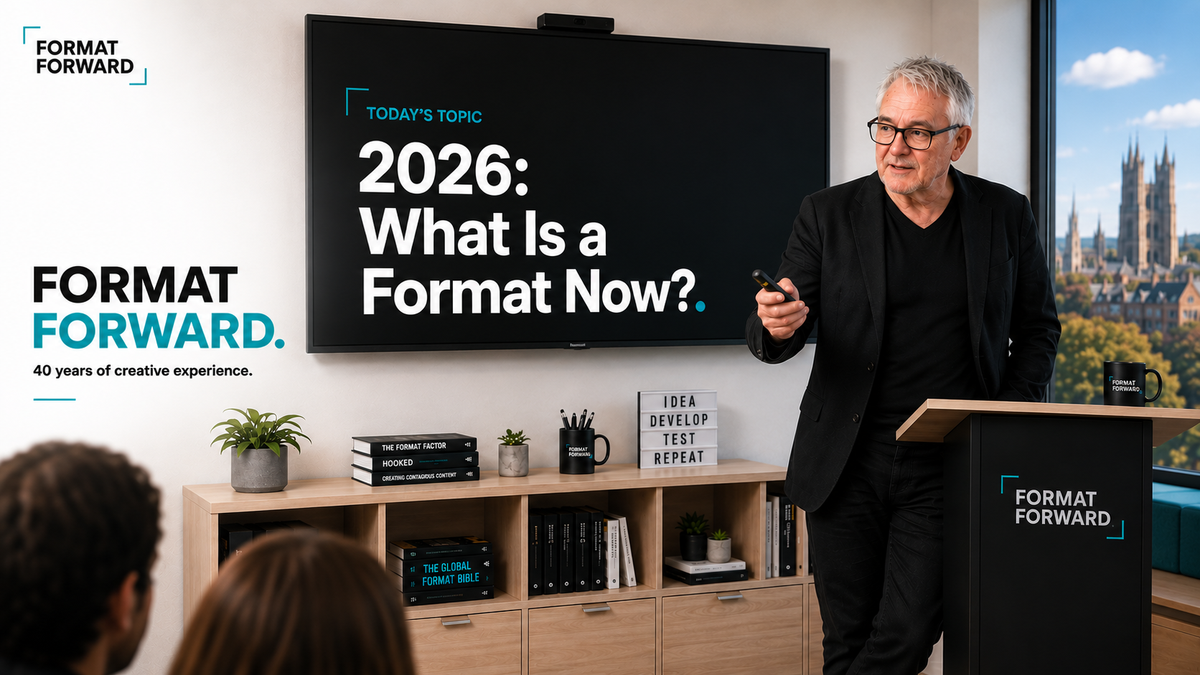
We need to talk about what a "format" is now, in this changed world of making stuff for people to watch.
There was a time when the word felt fairly clear.
If you said “format”, most of us knew the territory. A quiz show. A game show. A talent competition. A reality structure. A piece of television with rules, rounds, jeopardy, casting and a shape that could travel.
It belonged to the world of broadcasters, commissioners, schedules, pilots, paper formats and international sales.
That world still exists.
But it is no longer the whole world.
Something has shifted around us.
Unscripted ideas do not only live in broadcast schedules anymore. They begin on YouTube. They grow through creators. They get funded by brands. They become podcasts, clips, live events, communities, FAST channels, spin-offs and social habits. Sometimes the commission comes first. Sometimes it comes much later. Sometimes it never comes at all, but the idea still finds an audience and a business model.
At the same time, AI has made the surface of development easier than ever.
Premises can be generated quickly. Titles can be polished. Pitch lines can be sharpened. Worlds can be imagined. Decks can be dressed.
But that may make the deeper craft more valuable, not less.
Because the real question is not whether we can produce more ideas.
Of course we can.
The real question is whether we know what kind of idea we are building.
A programme behaves differently from a format.
A talent vehicle behaves differently from a repeatable engine.
A one-off documentary behaves differently from an adaptable unscripted system.
And if we confuse those things, we develop badly.
We pitch the wrong thing to the wrong buyer. We protect the wrong bit of value. We build decks when we need proof of concept. We chase commissions when we should be testing audience behaviour. We talk about IP when what we really have is a subject, a tone or a host.
So perhaps the starting point is not a new pitch.
Perhaps the starting point is a better definition.
For me, a format is "a repeatable structural blueprint that defines the rules, mechanics and progression of an unscripted concept across multiple episodes or platforms."
That definition matters because it forces a discipline.
It asks whether the idea can work again.
Whether it can change without breaking.
Whether it can move from one platform to another.
Whether it has a promise, a pattern and a reason to return.
In a market flooded with ideas, the value may no longer sit in having a premise.
It may sit in knowing whether that premise can become a format.