TV Format Market Reports 2026 | The Format Atlas
Seven territory reports on the 2026 format market. What "downturn" really means in each, before Edinburgh and MIP.

Seven format markets, seven different downturns
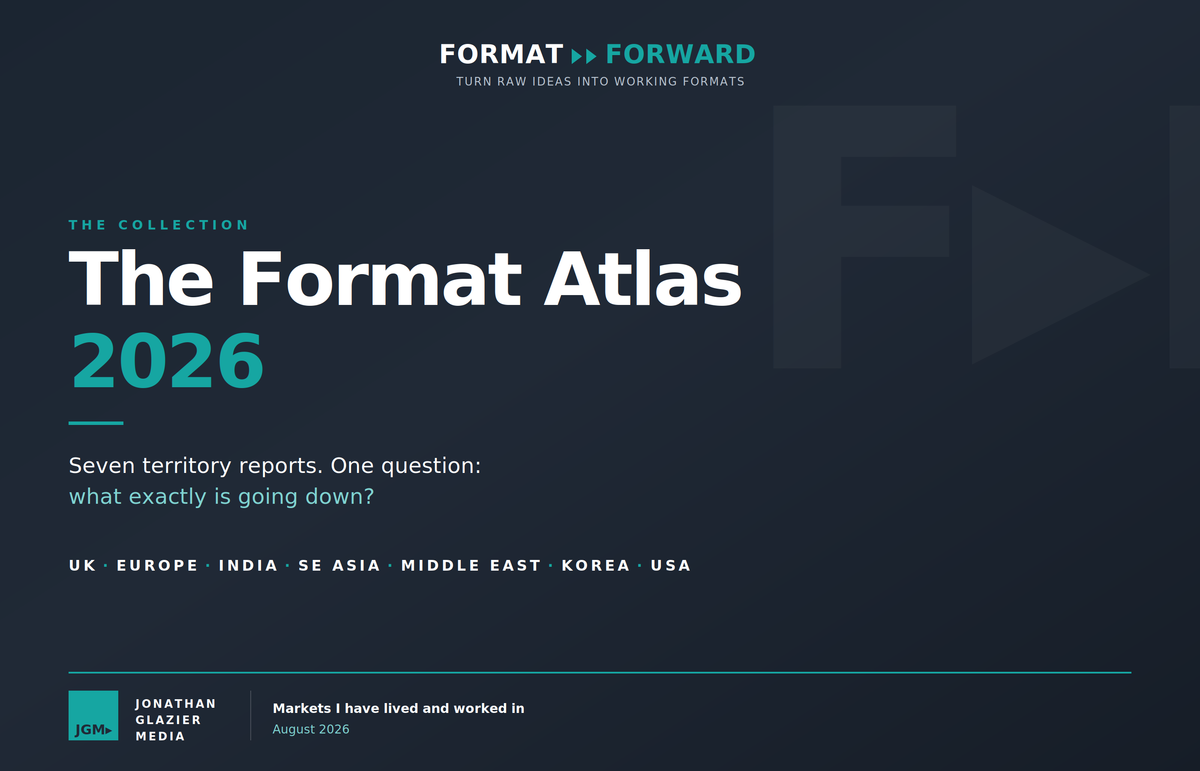
Edinburgh is on us and MIPCOM is next. Somewhere between the two, several hundred people will tell each other the market is down. I spent the summer checking what that actually means in seven territories. The answers do not match.
These are not markets I picked off a map. They are the ones I have lived and worked in, over four decades, which is the only reason I felt able to argue with the numbers rather than just report them.
TL;DR
- Every market here is described as contracting. In no two of them is the same thing contracting.
- The UK is making more television than ever and commissioning less of its own. India grew 9% while its TV advertising fell. Europe's commission count barely moved but everything takes a third longer to make. Korea exports more television per head than almost anyone and just watched a major broadcaster enter receivership.
- The AI question has been answered seven different ways, and the differences matter more than any single answer.
- Buyer consolidation happened everywhere at once, in the same twelve months, in seven separate markets.
- One market is still inventing new formats every year rather than remaking proven ones. It is not the one you would guess.
- Alongside the reports, four top 20s of the last ten years ranked by return performance instead of ratings. The UK edition does not include The Traitors, and that is the point. These are coming soon
Everything available is free to download at the bottom of this post.
Why now
Festival season is the one stretch of the year when the whole industry says the same sentence to each other in the same fortnight. Edinburgh, then the run-up to MIPCOM, and the line will be some version of "it's tough out there."
It is. But "tough" is doing an enormous amount of work in that sentence, and the moment everybody agrees on a diagnosis is usually the moment worth checking it. So I did, market by market, before the bar conversations start and the same received wisdom gets passed around for another season.
One thing to say up front about method. Everything at Format Forward is written through the lens of a development team, because that is the job I have done for forty years. It changes what counts as a fact worth having. A development team does not need to know which show had the biggest audience last season. It needs to know which mechanics keep getting recommissioned, which travel, and which die at series two. That principle runs through all seven reports and it is the whole argument behind the top 20 lists.
1. Nobody is talking about the same downturn
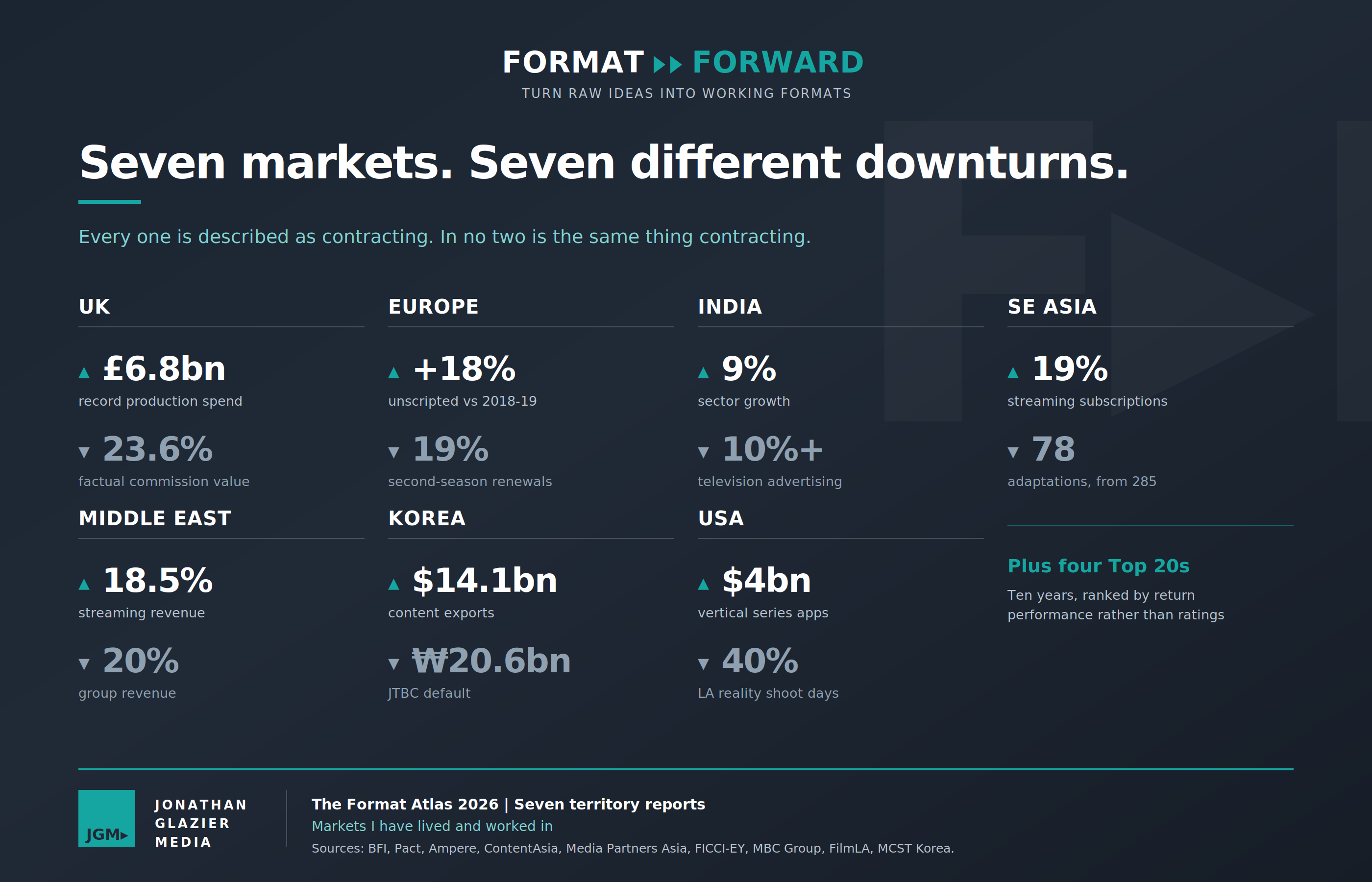
The UK is the clearest case of a market being read backwards. British film and high-end TV production spend hit a record £6.8 billion in 2025, up 22%, with around 85% of it inward investment. Strip that out and the number of domestic high-end programmes fell again, from 82 to 76. Pact recorded factual and factual entertainment commission value down 23.6%, with returning series taking 71% of commissioning value. So the UK is not in a content downturn. It is in a development downturn.
India grew 9% in 2025 and digital media crossed ₹1 trillion for the first time, while television advertising fell more than 10%. Same word, opposite situation. India's money is migrating, not disappearing.
South East Asia saw format adaptations across Asia fall to 78 in the first half of 2025 from a peak of 285 in 2017, while South East Asian streaming subscriptions rose 19% past 61 million. The region stopped buying one particular product. It did not stop buying.
The Middle East is the sharpest illustration. MBC Group's first-quarter revenue fell by around a fifth. In the same accounts, Shahid's revenue rose 17.5%, and across the half year its net profit went from SAR 2.7 million to SAR 54.2 million, pulling profitability forward by a year. One company, two directions, and most people quoting only the first number.
The USA repeats a statistic that measures the wrong thing. Reality TV logged 676 on-location shoot days in Los Angeles in the second quarter, down 40% year on year. That is Greater LA permit data. Commissioning data shows orders down roughly a third from their 2022 peak, not two thirds.
Europe barely fell at all. Western European scripted commissions in 2025 were only 2% below 2020. But the average time from order to release went from 288 days to 404. Europe's crisis is speed, not appetite.
Korea exports more television per head than anywhere on earth, and in June JTBC defaulted on 20.6 billion won while JoongAng Group affiliates filed for court receivership.
The takeaway: before accepting anyone's account of a market being down, ask what is down. Volume, value, location, speed, or genre. Those five answers lead to five completely different pitching strategies.
2. The AI question got seven different answers
This is the comparison I did not expect to find, and it is the most useful thing across the collection.
India industrialised it. JioStar released a 100-episode AI-generated Mahabharat that drew 6.5 million views on launch day at 2.1 times platform average. At ₹79 a month across a dozen languages, AI is arithmetic rather than ideology.
Indonesia tried and got shouted at. TRANS7's Legenda Bertuah was billed as the country's first fully AI-produced programme. Viewers called the characters lifeless.
The Gulf bought the infrastructure instead. Saudi Arabia's Humain led a $900 million round into Luma AI on the proposition that the next production centre is a data centre.
The UK chose disclosure over deployment. Channel 4 ran a Dispatches fronted by an AI presenter and revealed it in the closing moments, then said it would not become a habit.
America went backwards. OpenAI discontinued Sora as a consumer product in April and studio partnerships never converted, while one vertical platform targets 100 AI-generated short series a month.
Korea wrote the licence and charged for it. SBS became the first Korean national broadcaster to set a fee framework licensing its news archive for AI training. Around a third of Korean content companies now use generative AI in production.
Europe legislated. On 2 August the EU AI Act's transparency obligations took effect, with fines up to €15 million or 3% of worldwide turnover, and they apply to anyone whose AI outputs are used in the EU. A British producer whose show streams in Europe is in scope.
Seven markets, seven answers. The split is not about access to technology. It is about who has price pressure, who has audience tolerance, and who has an enforceable rights regime.
3. Everybody is losing something, but not the same thing
The UK lost companies, with Proper Content going into administration and Duck Soup Films stopping development entirely. America is losing the machinery: Quixote Studios gave up most of its LA stages, Shadowcast Pictures closed after nearly two decades, and reports suggest more than eighty production service companies have gone in four or five years. India lost around 1,100 roles to the JioStar merger and lost BBC Studios' Indian production business altogether. Singapore lost a taboo, with Mediacorp's 93 job cuts described as the first public layoff of its kind in the country's television industry. The Philippines came close to losing a broadcaster over a family argument. Korea lost an institution, since JTBC did more than any other company to raise the ceiling on Korean drama. And Europe lost time, which in a business where development is funded out of cash flow amounts to the same thing.
4. The buyer list shortened everywhere at once
There is no coordinating mechanism for this, which is what makes it remarkable.
Banijay and All3Media completed in July. Three days earlier Sky agreed to buy ITV's Media and Entertainment arm. Paramount Skydance outbid Netflix for Warner Bros. Discovery in a deal worth around $111 billion. MFE now controls a major commercial network in Germany, Italy and Spain simultaneously, with a pan-European platform coming in 2027. RTL absorbed Sky Deutschland. JioStar consolidated Viacom18 and Disney Star. Viu and iQIYI bundled rather than fought.
Seven territories, twelve months, and in every one the number of independent people who can say yes to your format went down. If your contact list is more than a year old, it is wrong. Worth fixing before Cannes.
5. The growth is in the format nobody is pitching
Short vertical series is the only category growing in every territory I looked at. India went from nothing to 100 million monthly active users in under two years. The US is the largest market outside China, with Fox committing to more than 200 vertical titles.
Here is the part that should interest a development team. Holywater runs an AI app explicitly as a testing bed, generating storylines, seeing which work, then producing the winners with actors. That is a development department with a live audience attached, running cheap versions of ideas before committing money. Broadcasters have wanted that for forty years and never built it, because pilots were expensive and audiences unreachable.
A vertical app built it in eighteen months, and traditional format development is almost entirely absent from the category.
6. And one market is still inventing
Netflix Korea's content director said the thing that most surprises his international colleagues is how Korea manages to release brand-new formats every year, when the overseas norm for unscripted is to remake something already proven.
That is the exact inverse of everywhere else here. Every other market is de-risking by buying mechanics that have worked before. Korea de-risks by backing producers with track records and letting them invent. Both are risk strategies. Only one of them generates new IP.
Meanwhile the Netherlands, a country of 18 million, generated format commissions in India, Spain, Australia, the US and the UK inside twelve months from a single company. Neither market had the option of a comfortable domestic audience. That is not a coincidence, and it is worth sitting with if your domestic market is getting less comfortable.
The top 20s: what happens when you stop counting viewers
Alongside the territory reports, I have been building a second study: a top 20 of the last ten years for each market, ranked by return performance rather than audience.
The method is deliberate. 40% of the index is return years, how many years inside the decade generated new local production. 30% is recommission depth, the repeated decisions to make it again. Then 15% continuity, 10% resilience through changes of host, channel or platform, and 5% territorial footprint, where genuine local adaptations count for more than finished-tape sales. Ratings are a tie-breaker, not the ranking.
Four are published: the UK, East Asia, Southeast Asia and India. Every one produced a result I did not expect.
The test of a method is whether it excludes things you would rather include. Asia's Got Talent is not in the Southeast Asia top 20. I know that show well, because I made it. Three seasons of a genuinely pan-regional production cannot compete on recommission depth with formats reaching seven, ten, twelve or sixteen cycles, and a show whose geography is its proposition sits awkwardly in a national ranking anyway. It belongs in the history of the region. It does not belong in this particular twenty. If the index bent to let it in, none of the other nineteen placings would mean anything.
The Traitors is not in the UK top 20. That is not an oversight, it is arithmetic. The UK version launched in November 2022, so by the end of the research window it has had a little over three and a half years to build evidence inside a ten-year study, while 70% of the index rewards demonstrated repeated return. Its impact is not in question. The first Celebrity Traitors finale averaged 11.1 million overnight, the biggest live audience of the year for a single show. But impact measures disruption and return performance measures proof. A new phenomenon can dominate the culture before it has had time to dominate a durability index, and it should climb fast in future rolling rankings.
What rises in its place is the stuff nobody calls a big format. Countdown, University Challenge, Pointless, Have I Got News for You and QI all place, because none of them needed a blockbuster launch to prove value. Come Dine With Me sits at ten with more than 2,000 UK episodes and commissions in over 45 territories. Repetition is not a weakness in this study. It is the evidence being measured.
Southeast Asia's strongest format market is not its largest. Thailand takes eight of the twenty places. Indonesia, with a population several times bigger, takes three. And the most strategically interesting title in the region is one most people outside Asia have never heard of: Mic On Debt Off, a Thai original from Workpoint that produced more than 700 domestic episodes and then travelled to Cambodia, Malaysia and Indonesia for 300 more. A smaller market that learned to buy, sustain, create and then resell.
India invents far more than its export record suggests. Ten of the twenty are Indian-origin, and five of those ten are dance properties, a genre outsiders write off as saturated. The problem is not invention. It is conversion, since very few of those engines have documented foreign adaptations. That finding sits directly alongside the India report in this collection, where Banijay Asia's Deepak Dhar makes the same argument from the other direction.
In East Asia, the surprise is Taiwan. Japan takes nine places and Korea eight, which you might predict. Taiwan takes three from a far smaller market, with All Star Strategy scheduling past episode 1,400, Mr Player around 585 and The Hunger Games around 494. That is a market almost invisible to anyone whose research starts with English-language trade coverage.
The single sentence I would take from all four is this. The most export-famous show is not necessarily the strongest returning format, and the strongest returning format is not necessarily the one from the biggest market.
Through a development lens that matters more than any ratings chart. A successful launch makes a hit. A successful return begins to make a format. Repeated successful returns make an institution.
The Atlas Format Reports
Free downloads
Seven territories, one research brief each. What is actually being commissioned, who is thriving, the closures that shook people, the local development worth studying, and how each market is really using AI. Sources and method are in every one, and I have worked in all seven.
The United Kingdom
The Format Atlas 2026: United Kingdom — record production, hollowed-out development. Why 71% of commissioning value now goes to shows that already exist.
Europe
The Format Atlas 2026: Europe — the exchange everyone else trades on. The velocity crisis, the consolidation, and the first binding AI disclosure law in television. Includes Israel and Turkey, and the reasoning for both.
India
The Format Atlas 2026: India — the market that stopped waiting for permission. Microdrama, mythology and the boldest AI bet in television.
South East Asia
The Format Atlas 2026: South East Asia — the format market nobody is reading right. Adaptations down, subscriptions up, and why a pan-regional pitch loses.
Middle East
The Format Atlas 2026: Middle East — one buyer, one month, and a very long game. Ramadan as a commissioning system, and where the Gulf really put its AI money.
South Korea
The Format Atlas 2026: South Korea — the last market still inventing formats, and the one whose broadcasters are going under while it does.
USA
- The Format Atlas 2026: USA — the format business left the building. What the LA numbers actually measure, and where the work went.
- The Top 20 Returning Formats in the UK — ten years of return performance, and why The Traitors is not on the list. [link]
- The Top 20 Returning Formats in East Asia — Japan, Korea, Taiwan, Hong Kong, Mongolia and Macau. Mainland China deliberately excluded, with the reasoning stated. [link]
- The Top 20 Returning Formats in Southeast Asia — why Thailand beats Indonesia eight places to three. [link]
- The Top 20 Unscripted Formats in India — half the list is home-grown, and almost none of it travels. [link]
All of it is here now. Over the coming weeks I will take one territory at a time and argue with it properly, because there are findings in each of these that deserve more than a paragraph.
If you want one question to carry into Edinburgh and on to Cannes, take this one: which of these seven markets is your format actually designed for. In 2026, "international" is no longer an answer.
Jonathan Glazier Format creator and executive producer alt.Media
I am dyslexic. AI helps me make my writing readable. The thoughts and opinions are my own. There are no auto-generated articles here, and I read and research with rigour.