Format Lab: The Traitors, Teardown #1
The Traitors stripped to its six core mechanics. A format developer's teardown showing which parts of the engine you can reuse, and how to avoid a clone.

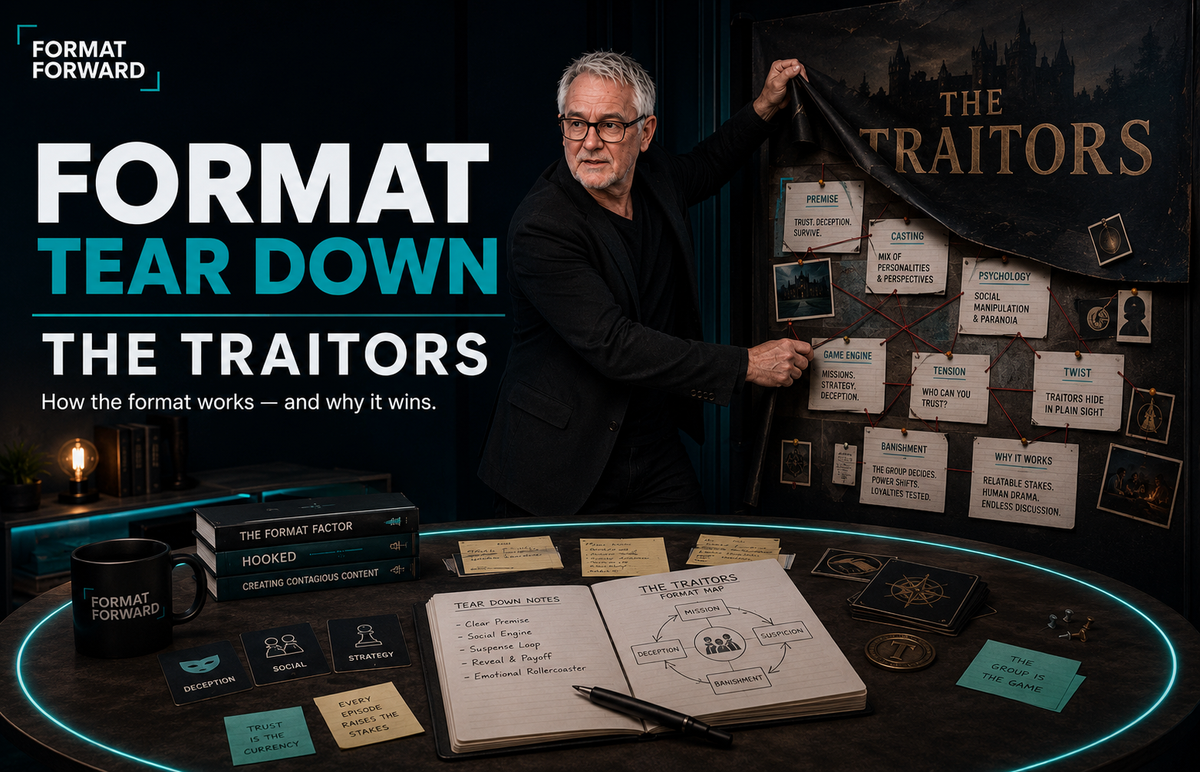
Format Lab is where I take a hit format apart on the workbench and show you which components you can legally, creatively, and commercially reuse. This is the first one. It had to be The Traitors.
TL;DR: The Traitors is not a new idea. It is a 40-year-old parlour game with world-class production dressing. The protectable value is in the wrapper, not the engine. Which means the engine, an informed minority hidden inside an uninformed majority, is sitting there for any developer to build on. This teardown strips the format to its mechanics and shows you how to transfer them into new ideas without making a clone.
Why I'm starting here
I have a personal stake in this one. Years before The Traitors reached the BBC, I tried to get a TV version of Mafia away. We shot the pilot in Moscow, which gave the whole thing its darkness. It came close. It didn't land. So when De Mol's version arrived and became a global juggernaut, I watched it with the specific attention of someone who knew exactly what was under the bonnet.
That failure taught me something useful for this column: the mechanic was never the problem. The mechanic has been proven since Dimitry Davidoff invented Mafia at Moscow State University in 1986. What my pilot lacked, and what The Traitors nailed, was the wrapper. Keep that distinction in mind. It is the whole lesson.
Summary
Overview. A group of strangers competes for a shared prize pot. A small number are secretly designated Traitors. The Traitors know each other. The Faithful know nothing. Each night the Traitors "murder" a Faithful. Each day the whole group banishes someone by vote, hoping to catch a Traitor. If any Traitor survives to the end, they take everything.
Core structure. A daily loop with two elimination events: one covert (murder, controlled by the informed minority) and one public (banishment, controlled by the majority). Missions build the prize pot and provide daytime activity. Shields offer limited protection. Recruitment lets Traitors replace their losses.
Features. The round table. The cloaked conclave. The breakfast reveal. A host who performs theatrical menace rather than neutral moderation. A final endgame where remaining players must decide to share or steal.
Format. Stripped scheduling, castle location, cinematic gothic grade, casting skewed to ordinary people rather than celebrities in the flagship versions. Roughly 12 episodes per season, structured for nightly consumption and next-day conversation.
Appraisal
Strengths: the engine, broken into transferable parts
This is the section that matters if you develop formats. The Traitors is really six mechanics bolted together, and each one travels independently.
1. Information asymmetry. One group knows more than the other, and the audience knows more than both. That last part is the piece developers keep missing. The viewer's experience is dramatic irony, not mystery. We know who the Traitors are from episode one. We are not solving a puzzle, we are watching people fail to solve one. Any format you build on this engine must decide where the audience sits in the information hierarchy, and "above everyone" is usually the right answer.
2. The double elimination loop. Two exits per cycle, one secret and one public, means the cast shrinks fast and every episode has two guaranteed story beats before anything else happens. Compare that with formats that limp along on one weekly elimination. The cadence is a scheduling asset as much as a dramatic one.
3. Consequence attached to conversation. The gameplay is talking. That is it. Missions are decoration. The genius is that every conversation carries a potential death sentence, so ordinary chat becomes loaded. If you can attach real consequence to social behaviour, you have a format. If you can't, you have people in a nice location having opinions.
4. The self-repairing antagonist pool. Recruitment is the most underrated mechanic in the show. When a Traitor falls, the Traitors can replace them, often by seduction or blackmail of a Faithful. This keeps the engine running to the final episode and creates the show's best character arcs, the Faithful who crosses over. Most competition formats decay as villains get eliminated. This one regenerates its own conflict.
5. Collective pot, individual betrayal. Everyone builds the money together. Then the endgame asks whether the survivors will share it. The whole season is a prisoner's dilemma with a twelve-episode fuse. The pot converts teamwork into tension rather than resolving it.
6. Ritual. Round table, breakfast, conclave. Fixed, repeated ceremonies that the audience learns and anticipates. Ritual is cheap to produce and expensive to skip. It is what makes a game feel like a world.
Challenges
Be honest about the weaknesses before you borrow the strengths. The Faithful almost never win through deduction; banishments are closer to social scapegoating than logic, and across multiple territories the Traitors' win rate exposes how unbalanced the game really is. That imbalance works for this show because failure is the entertainment. It will not work for every derivative. There is also a duty-of-care question that developers can no longer treat as an afterthought. A game built on engineered paranoia, group accusation and public shaming needs psychological support baked into the production plan, not bolted on when a compliance department asks.
And the biases the show exploits, confirmation bias, groupthink, the rush to consensus, are the same ones I wrote about when the format first aired. They are powerful precisely because contestants cannot switch them off. Handle with care.
Improvements, or rather, transfers
Here is the working method I use, and the one I'd suggest for your development slate.
Step one: strip the format to a sentence with no nouns from the show in it. For The Traitors: an informed minority hidden inside an uninformed majority, with consequence attached to conversation. No castle, no cloaks, no Claudia. If your sentence still contains the wrapper, you are developing a clone and a lawyer will eventually explain the difference to you.
Step two: move one variable at a time. Change the setting, the stakes, the information structure, or who holds the asymmetry. Some directions worth developing:
- Invert the asymmetry. What if the majority is informed and the minority is not? A show where one or two players don't know the real rules of the game everyone else is playing. The Joe Schmo Show touched this years ago. It has never been done with modern production values and a fair-outcome mechanic.
- Move the consequence. In The Traitors the consequence of conversation is elimination. Make it financial instead, every accusation costs money from your own stake, and you get a completely different risk economy with the same engine.
- Change the recruitment vector. A workplace or family version where the "traitor" role passes involuntarily, like a virus, so nobody is safe from becoming the thing they are hunting. That converts the format from us-versus-them into a study of what people do with unwanted power.
- Compress the loop. The daily murder-banishment cycle could run as a stripped daytime half-hour with a rolling cast, closer to a game show than a reality epic. The engine does not need a castle. It needs a table and stakes.
- Take it out of the bubble. The mechanic played across a real community, a village, an office, a sports club, with the informed minority operating in participants' actual lives, is the high-risk, high-reward version. Compliance will fight you. The tension would be extraordinary.
Step three: rebuild the ritual. Whatever world you build, give it its own round table. A repeated, named ceremony where the consequences land. This is where your format stops being a mechanic and starts being a show.
The developer's takeaway
The Traitors proves something I bang on about constantly: gameplay is not protectable, execution is. Mafia sat in the public domain for decades. Werewolf variants circulated at every games night in the world. The value De Mol added was tone, ritual, casting philosophy and a production grammar that made a parlour game feel like cinema.
So do not chase the next Traitors by writing "Traitors but on a boat." Strip it to the engine, move a variable, and build a wrapper nobody has seen. The engine is free. The wrapper is where your format fee lives.
That is what Format Lab is for. Next time, another format on the bench.
I'm dyslexic. AI helps me make this readable. The thoughts, opinions and research are my own, there are no auto-generated articles here, and I read and research with rigour.