How Do We Measure a Successful Commissioning System?
What does a good BBC commissioning system actually look like? Not hit rate, but how cheaply it finds failure and what it's still creating five years on.

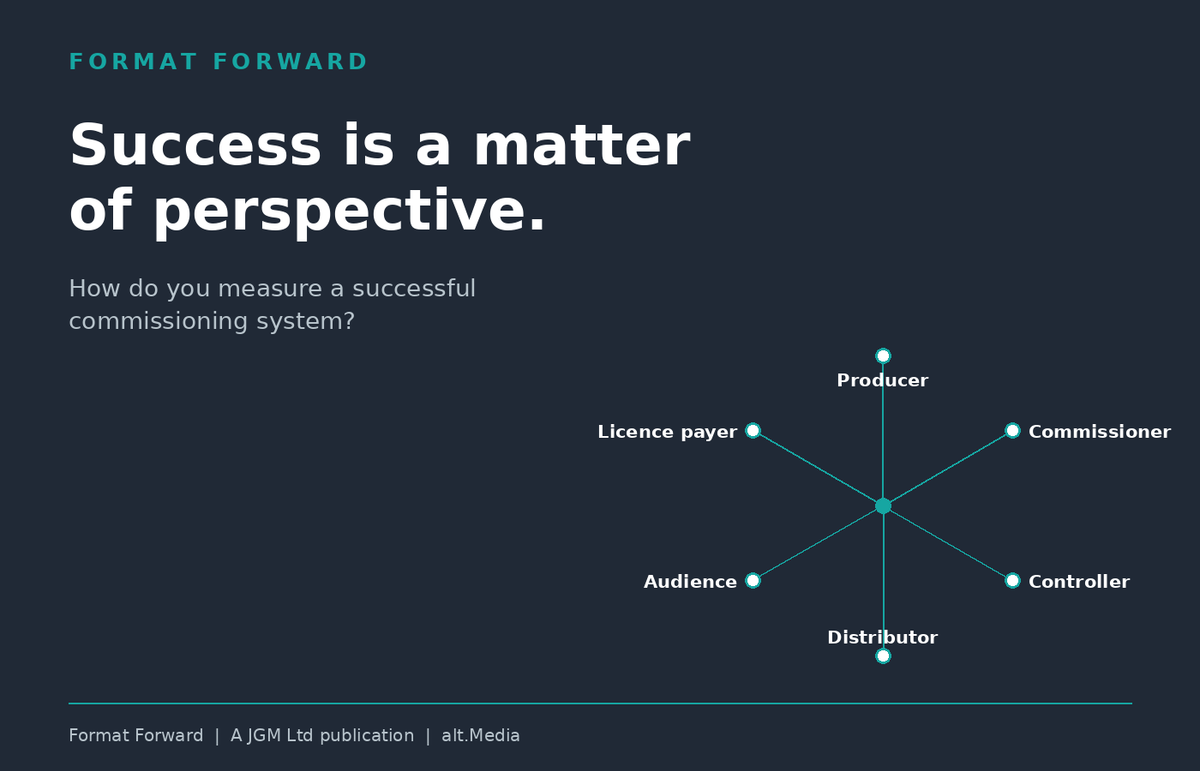
Success is a matter of perspective.
Like the universe, it's relative to where you're standing.
I'd also like to say that it's a shame that words can get hijacked. "Reform" is just a word, but now it is a word that sends a shudder down many readers' spines. So what a shame my colleagues decided on their latest rant at the BBC to be titled, "Reform the Industry"; what do you think?
I've been thinking about that a lot while compiling Format Forward's Top 20 formats. Measuring the success of a television format turns out to be considerably harder than I thought. Is a format successful because it sells to 20 countries? Because it runs for ten series in one? Because it rates? Because it makes money? Because it is still being commissioned 15 years after it was created?
The answer depends on where you're standing.
And I wonder if exactly the same problem sits at the heart of the current debate about BBC commissioning.
There is now a call for reform, supported by hundreds of people from across the production community. At almost exactly the same moment, Kate Phillips has been talking to Broadcast about restructuring BBC commissioning, cutting development expenditure by 15%, experimenting with cheaper proofs of concept and trying to stop projects getting stuck in what she herself calls "development hell".
There is clearly a conversation to be had about commissioning.
But before we decide whether the system is succeeding or failing, perhaps we need to answer a more fundamental question.
How do we measure a successful commissioning system?
Because I'm not sure we've ever really agreed.
If you're a producer, the first measure of success is fairly obvious. You got the commission.
But even that isn't quite as simple as it sounds.
If you spent two years developing the idea, carrying staff, attending meeting after meeting, making changes and waiting months between decisions, was it still a successful process?
Probably, if you got the commission.
Definitely not, if you didn't.
Move to the other side of the desk and the view changes.
For a commissioner, getting programmes made is only the beginning. They have to find ideas that fit the channel, work for the audience, justify their cost and ideally return. At the BBC they also have public-service obligations, regional responsibilities and a requirement to do things the market might not otherwise do.
Move upstairs again to the channel controller and you're looking at a portfolio. One programme might deliver a huge audience, another a younger audience, another reputation, another underserved viewers and another might drive people to iPlayer.
Then there is the distributor who looks at the same programme and asks whether anyone in Germany, Australia or Korea might buy it.
And eventually there is the audience, who couldn't care less about any of this.
They either watch it or they don't.
Which brings me back to something that struck me while doing the Top 20 research.
We measure programmes obsessively once they have been commissioned. Ratings, share, streams, demographics, appreciation, awards, recommissions, international sales.
But we know remarkably little about the performance of the machine that chose them.
What if we did?
Not as a league table of commissioners. I think that would be both unfair and potentially damaging. If you tell commissioners their performance will be judged purely by hit rate, don't be surprised when they stop taking risks.
But there are things we could know.
How many ideas enter the system? How many go into paid development? How many become proofs of concept or pilots? How many finally get commissioned? How long does that journey take? And perhaps just as importantly, how quickly does the BBC say no?
That last one matters.
An unsuccessful idea sitting on a commissioner's desk for three months costs the BBC very little. It can cost an indie quite a lot.
People. Time. Development money. Opportunity.
That's why one comment from Kate Phillips' Broadcast interview particularly interested me. She said the BBC needs to be realistic about how much it develops and must stop projects getting trapped in development hell. If the BBC isn't going forward, she wants the idea put into turnaround quickly so the producer can take it elsewhere.
That sounds simple.
It could actually be one of the most useful measures of commissioning efficiency.
Because perhaps failure isn't the problem.
Television development has to fail. It is R&D. If every idea you develop gets commissioned, you're probably not taking enough creative risk.
The important question is how intelligently and how quickly you discover that an idea isn't going to work.
That changes the conversation around the BBC's 15% reduction in development spending too.
The objective shouldn't simply be to develop fewer ideas.
It should be to make failure cheaper to discover.
A paper format might answer one question. A run-through another. Animation another. A £5,000 digital proof of concept might tell you something that once required a £100,000 pilot. And increasingly an idea might even prove an audience for itself online before anyone commissions a television version.
That doesn't remove creative risk. It allows you to take more of it.
Then comes the measure I increasingly think we've undervalued.
Time.
When I started looking at successful formats across the past decade, international sales initially seemed like the obvious measure. But selling a format once and having it cancelled tells you something very different from a programme returning year after year in the same territory.
Recommissioning is evidence.
The broadcaster has seen the ratings, seen the costs, heard from the audience, dealt with the production and then made the decision to buy it again.
And again.
Perhaps we should judge commissioning in much the same way.
Not simply, what did you commission this year?
But, five years later, what did you commission that is still creating value?
That might be a returning series. It might be valuable IP. It might have created a new piece of talent. It might have established a production company. It might have travelled internationally. It might even have failed commercially but demonstrated something genuinely new that subsequently influenced other programmes.
Success doesn't have to mean the same thing every time.
But it does have to mean something.
And at the BBC there is one final person standing in a different place looking at all of this.
The licence-fee payer.
We should care whether commissioning uses public money efficiently. But efficiency cannot simply mean spending less.
A commissioning department that saves millions by becoming increasingly cautious may look wonderfully efficient on a spreadsheet while slowly destroying the thing it exists to create.
Equally, creativity cannot become an excuse for a system that leaves hundreds of ideas floating around in development because nobody wants to make a decision.
We need risk and accountability.
Which is why I think the current argument about reforming BBC commissioning could become much more interesting than an argument about whether individual commissioners are good at their jobs.
I'd rather know whether the system is good at its job.
Does it find ideas from unexpected places? Does it recognise potential? Does it make ideas better? Does it kill the weak ones quickly enough? Does it protect the unusual ones long enough to find out whether they're brilliant? And does it give the people who brought those ideas into the system a clear answer in a reasonable amount of time?
Most importantly, five or ten years later, what did all that commissioning actually create?
Because perhaps the measure of a successful commissioning system isn't how many programmes it commissions.
It's how much lasting value it creates from the ideas, money, talent and risk that pass through it.
And that depends entirely on where you're standing.
I'm dyslexic. AI helps me make this readable. The thoughts and opinions are my own, there are no auto-generated articles, and I read and research with rigour.