The Three Ways a TV Format Dies: Failure Models Every Developer Should Know
Why do TV formats fail? Three failure models, from The Neighbourhood to Limitless Win to Cash Cab, and a diagnostic checklist for format developers.

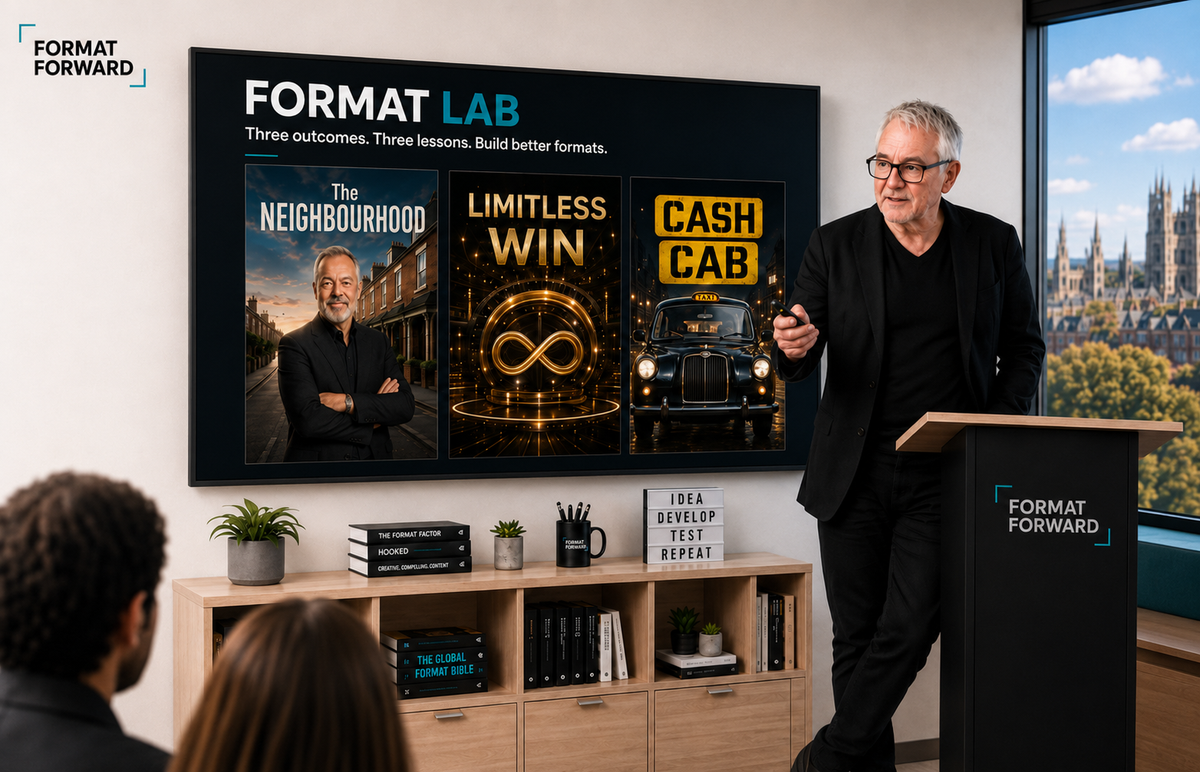
TL;DR: Every failed format dies one of three deaths. Either the format is broken, the format is unbuyable, or the execution was broken. Knowing which one killed a show tells you more about development than any hit ever will. Development departments study hits obsessively. We tear down The Traitors, we map the Millionaire money ladder, we quote Got Talent economics at each other in pitch meetings. But we almost never study failure. That's a mistake. A hit tells you what worked once, in one place, with one host, in one slot. A failure tells you where the load-bearing walls are. And when you're developing new ideas, knowing where formats break is worth more than knowing where they shone. So this week's Lab is an autopsy. Three bodies, three causes of death.
The three failure models
First, a definition. For this piece, failure is ratings-led. Poor numbers, cancellation after one or two series. Not critical failure, not awards failure, commercial failure. Within that, there are three distinct models: Total failure. The show fails in its launch territory and gets no international pickup. Nothing survives. Local success, no travel. The show works at home, returns for multiple series, but no other territory makes a version. Local failure, international success. The show dies at home, but the format sells and thrives abroad. Each one points to a different diagnosis. Let's take them in turn.
Model 1: Total failure. The Neighbourhood
ITV launched The Neighbourhood in April 2026 with everything a broadcaster can throw at a show. A £250,000 prize. A purpose-built street in Derbyshire. A huge promotional push. And Graham Norton, one of the safest bets in British television for two decades, in his first reality hosting role. By episode three it was down to around 500,000 viewers. Within weeks, ITV pulled it from its 9pm slot to 10.45 pm and filled the gap with a two-year-old episode of Long Lost Family and a Beat The Chasers repeat. Here's why this one matters for developers. When a show fails with a genuinely major local name attached, the talent alibi disappears. You cannot say the host was wrong. Norton was the strongest possible insurance policy, and the policy didn't pay out. That points the finger squarely at the format. And the mechanical diagnosis was visible in the reviews. Critics said it lacked the psychological intrigue of a Traitors round table. Households competing to be popular sounds like a premise, but popularity is not a game mechanic. There was no engine, no escalating jeopardy, nothing forcing decisions that cost something. Two aggravating factors are worth noting. ITV dropped the full box set on ITVX at launch, which likely cannibalised linear numbers. And The Neighbourhood followed Genius Game and The Fortune Hotel into the same grave, all ITV originals chasing The Traitors, all cancelled. Chasing a hit is not the same as understanding why it was a hit. Cause of death: broken format. Talent could not save it because talent was never the problem.
Model 2: Local success, no travel. Limitless Win
Now the opposite case. Ant & Dec's Limitless Win launched on ITV in January 2022 to over 6.3 million viewers. It has since given away more than £3.5 million, been streamed 13 million times, reached over 25 million viewers, and holds the strongest 16-34 profile of any quiz show on any channel. ITV has ordered it through to series five and six plus Christmas specials. By any domestic measure, a hit.Internationally? Nothing. And it's not for lack of trying. Banijay holds the format rights, and Endemol Shine North America was pitching it hard to US buyers as early as 2022, calling it one of the highest-rated formats out of the UK in years. Four years later, no international version exists. So the failure is not distribution effort. It's buyer conversion. And that distinction matters, because it tells you the objection is on the buyer's side of the table. I'd point to two suspects. The first is right there in the title. Limitless. An uncapped jackpot is a thrilling promise on screen and a nightmare on a spreadsheet. UK broadcasters can insure and structure around it, but ask a commissioning editor in a smaller market to sign off on a theoretically infinite liability and watch the meeting end early. The second is host dependency. Even the lukewarm reviews conceded the point. The Guardian called the format Millionaire with a few bells and whistles, but praised Ant and Dec's hosting as their most effective new venture in two decades. If the magic lives in the double act rather than the mechanic, what exactly is a foreign buyer buying? Most territories don't have an Ant and Dec. Some don't have one of them. Cause of death abroad: unbuyable format. The engine runs, but nobody else can afford the fuel or replace the drivers.
Model 3: Local failure, international success. Cash Cab and LEGO Masters
This is the category people forget exists, and it's the most instructive of the three. Cash Cab launched on ITV in 2005. A quiz in the back of a black cab, unsuspecting passengers, three strikes and you walk. ITV lost interest almost immediately. The second series was dumped as filler around the 2006 World Cup, and fourteen episodes never aired on the original network at all. Even all3media's own formats chief admits the UK original went largely under the radar. The format has since been commissioned in around 48 countries, produced over 9,000 episodes worldwide, and the US version on Discovery won three Daytime Emmys.LEGO Masters is the gentler version of the same story. Channel 4 aired two series in 2017 and 2018, then quietly dropped it. The format sold to Denmark, Germany, Australia, the US, the Netherlands, France, Poland and more. The Australian version became a primetime juggernaut for Nine. And here's my favourite detail: Channel 4 now imports the Australian version to fill its own schedule. The originating broadcaster buys back the foreign edition of the show it cancelled. What do these tell us? The engine was sound in both cases. Cash Cab has a perfect jeopardy loop, real stakes, a natural clock, and it costs almost nothing to make. LEGO Masters has universal IP, visible craft, and a built-in family audience. Neither format was broken. The local execution was. Wrong slot, wrong channel priorities, wrong moment.Cause of death at home: broken execution. The format outlived the broadcaster's patience.
The developer's diagnostic
So three models, three diagnoses. Broken format. Unbuyable format. Broken execution. The useful move is to run this in reverse, before you pitch. Ask which failure model your idea is most exposed to: The Neighbourhood test. Strip away the talent and the production spend. Is there an actual mechanic underneath, with escalating jeopardy and decisions that cost something? If your premise is a situation rather than a game, you're exposed to model one. The Limitless test. Can a foreign CFO budget your show? Is there anything in the mechanics, the prize structure or the title itself that scares a buyer in a smaller market? And does the format survive without its dream host? If not, you're building a local hit at best. The Cash Cab test. Does the engine work stripped of everything? At 3pm on a Tuesday, in another language, on a smaller budget? If yes, the format may deserve more faith than any single broadcaster will give it. Which is an argument for protecting your international rights position even when the home run stumbles. Hits are seductive, and failures are honest. Study the honest ones.
You will find a download in the toolkit to help you identify which failure your idea is vulnerable to.
Jonathan Glazier, Format creator and executive producer
Transparency: I am dyslexic, and AI helps me make my writing readable. The thoughts and opinions are my own. There are no auto-generated articles here, I read and research with rigour.