What Leave Meant on the Married at First Sight Sofa
Channel 4’s review wanted one Leave card to end a MAFS pairing. Here’s what that rule change would have done to the show, and the test I’d take into development.

Channel 4 will spend the money on new programmes. I’ve already written about why it cancelled the show. This week I want to look at the rule at the heart of it, because that’s the bit a developer can take away.
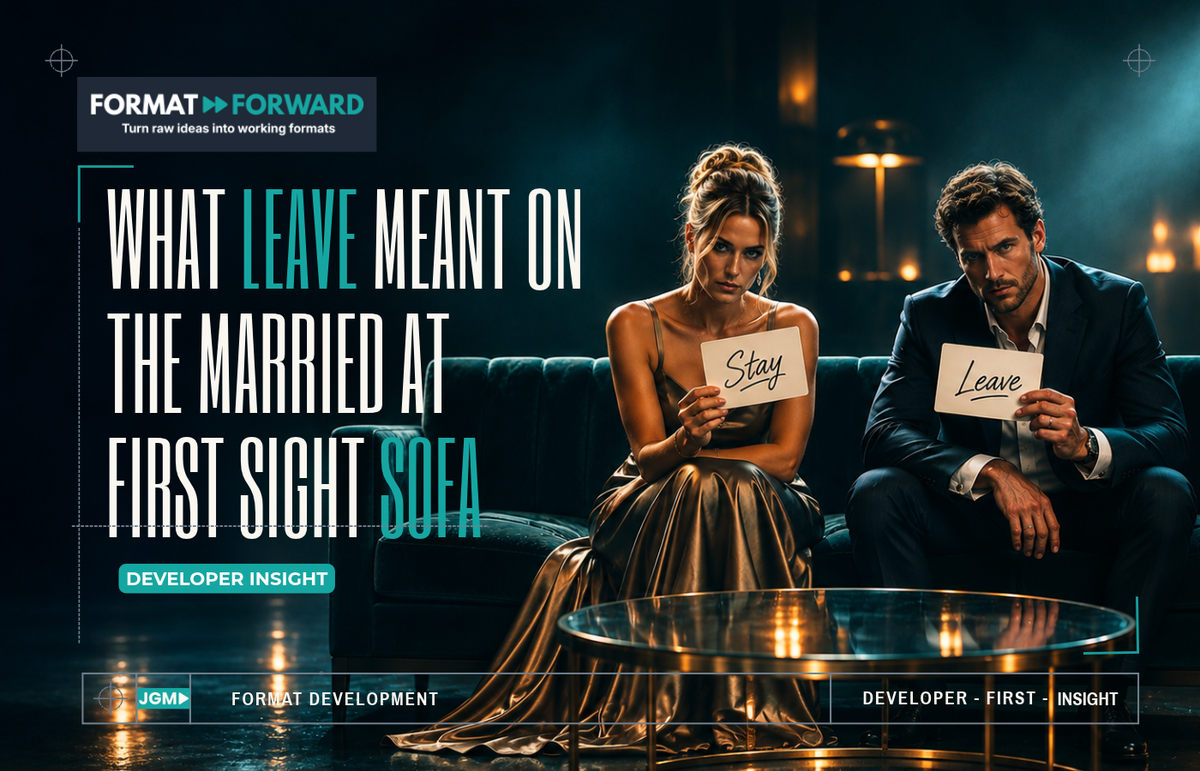
Anita wrote Leave. Paul wrote Stay. They both came back the following week. At the next commitment ceremony, they both wrote Leave, and their time on Married at First Sight UK ended. [Radio Times]
Now take that first ceremony from the 2025 series and replay it under the rule the external review recommended. One Leave ends the pairing. Same sofa, same experts, same two cards. This time Anita and Paul go home a week earlier. [Channel 4 review summary]
Except I’ve just made a big assumption. If you change what the cards mean, why would you expect people to write the same thing?
That’s the Format Forward question this week. Channel 4 has ended the UK edition and says it will use the budget to commission new programmes from British indies. That matters. But for anyone developing a format, the more interesting question is whether the changes would have left the viewer watching the same show. [Channel 4, 5 November]
The wedding gave us the premise. Repair gave us the series.
Two strangers meet at the altar. That gets me to episode one. What gets me to episode twenty is the cycle of disruption and repair. Two people fall out. We hear two accounts of the same row. Somebody offers advice. One of them promises to do something differently. And next time they sit down to dinner, I want to know whether they actually did.
The commitment ceremony gave that story a shape. Two Leaves and the journey ends. Two Stays and it continues, either because they’re loved up or because they’ve had a rotten week and both want to make it work. But a Leave and a Stay? Now we have a couple who disagree about whether there ought to be a next week. Under the old rule, they got one. [ITV News]
For me, the key person on that sofa was the reluctant stayer. Not the partner who wrote Stay. The partner who wrote Leave and came back.
I don’t know what Anita intended beyond what she wrote, and I wouldn’t presume to tell her. I’m talking about what the rule allowed a card to do. A contributor could mean I want to go. But Leave could also register a protest that Stay couldn’t express: I can’t do another week like the one we’ve just had. And because the card was revealed in front of the experts, it could carry a plea for help: Do you understand how bad this has become? What would we have to do differently?
That’s where the marriage-counselling element came in. The split vote put a specific disagreement in front of the experts, so they had something to work on beyond asking how the week had gone. And the viewer had a reason to come back beyond the promise of another row. Had the advice made any difference?
What happens when Leave can only mean goodbye?
Suppose I’m unhappy enough to want help but not sure I want the relationship to end. Under the old rule, writing Leave was a gamble, because my partner might write it too. Under the proposed rule there’s no gamble. My card alone ends the experiment for both of us. So perhaps I write Stay. My partner does the same. We’ve had exactly the same rotten week, but the two cards now tell a much tidier story than the one we’re living.
A good expert could still uncover the disagreement, and two people who choose to stay can still benefit from advice. So I wouldn’t say the change removes counselling from the programme. What it removes is the moment when one person can use the vote itself to say, in front of their partner and the experts, something has to change. Perhaps the argument happens later, back at the apartment. Perhaps they try to sort it out themselves. The disruption and repair might carry on, but the viewer no longer has the same seat in the room.
And what about the jeopardy? Under the old rule, once we’d seen the first Leave, the second card answered two questions: How does the other person feel? and Will we see this couple next week? Under the proposed rule, the second card can still break your heart. It just can’t change the outcome.
There’s an uncomfortable truth on the other side of my argument. The old rule bought that extra week of television at the expense of the person who had written Leave. A mechanic can produce a compelling episode without justifying what it asks of a contributor.
Channel 4 commissioned the review after former contributors made serious allegations of sexual misconduct, which the men concerned denied. Neither part of the review set out to rule on those allegations. Lorraine Heggessey concluded that the production could continue with stronger safeguards and changes to the format. Channel 4 chief executive Priya Dogra judged that the full package would alter the show fundamentally and that, after ten years, it had run its course. Those are different judgements, and both can make sense. [Channel 4 review summary]
Not every recommendation changes the show in the same way. Give the couple separate bedrooms on honeymoon and you can still tell a story about whether they choose to grow closer. Take out Partner Swap Week and you lose a sequence the team can plan before casting starts. But change the meaning of Leave and you alter how every contributor might approach every commitment ceremony, including the ones where both write Stay. That’s the change I’d test first. [Recommendations]
A question for every territory
The Australian edition supplied the template for the British revamp. Now the decision has travelled the other way. On 6 November, Channel 4 told Broadcast it did not intend to show future international editions. Existing Australian, US and New Zealand series stayed on its streaming service at the time, and Nine had already announced a fourteenth Australian series for 2027. So a British welfare review has had a commercial consequence for the Australian show without making any finding about the Australian production. [Broadcast, 6 November] · [Nine’s 2027 slate]
Snowman Productions created Married at First Sight. Seven.One Studios International licenses the format worldwide. The UK recommendations don’t dictate what every territory must do. But I would treat this as an early warning wherever the same rule operates. My question for Seven.One is a practical one: if a local producer wants to change the exit rule, can they do it themselves, or does somebody have to approve it? The public credits don’t answer that. [Channel 4 credits] · [Seven.One’s format deals]
My verdict? I’d still recognise the weddings, the dinner parties and the sofa. But without the reluctant stayer, I don’t think I’d be watching quite the same show. What I’d miss isn’t the power to keep someone there. It’s the moment someone can tell their partner, the experts and the audience that the relationship is in real trouble, and ask for help while there’s still a relationship to work on.
That’s the test I’d take into development. Give a contributor an unequivocal way to say “I’m leaving.” Then give them an equally clear way to say “I want help before I decide.”
The old format asked one card to do both jobs.
Jonathan Glazier
Format creator and executive producer, altMedia
TV format consultant and former BBC Head of Light Entertainment and International Formats
I am dyslexic. AI helps me make this readable. The thoughts and opinions are my own. There are no auto generated articles and I read and research with rigour.