Wonka's The Golden Ticket: Teardown
Netflix had the IP, the budget and a full-scale chocolate factory. So why didn’t Wonka’s The Golden Ticket break out? A teardown of the game engine, plus what my Premortem found before launch.

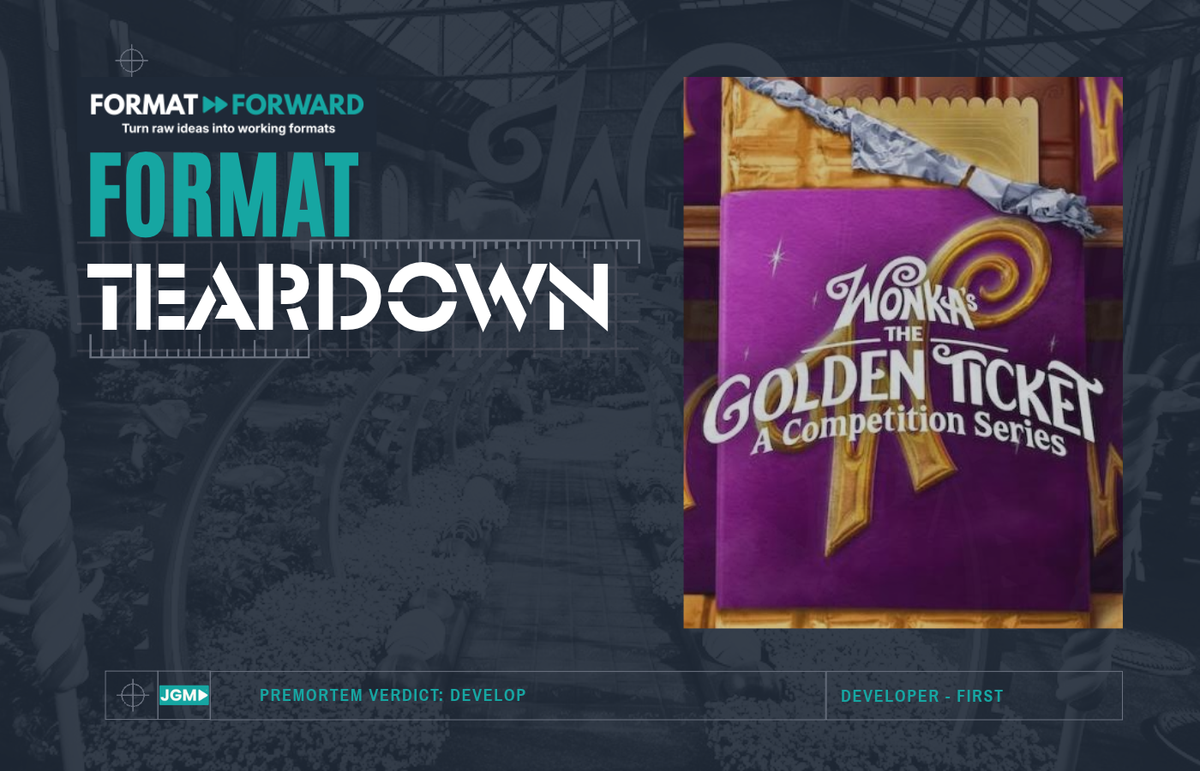
A brilliant world in search of a game: Wonka's The Golden Ticket
My good friend Simon Lythgoe asked me what I thought of Netflix's Wonka's The Golden Ticket. I'd already marked it down as a format worth examining.
It had everything going for it. A big budget, one of the best-known stories in the world, a purpose-built chocolate factory and a global launch on the biggest streamer there is. So did it make an impact? And if it didn't, why not?
That makes it a good case study. This is it.
The format in brief
Twelve Golden Ticket winners, each with a partner of their choosing, walk into Willy Wonka's factory. Every room sets a new test, physical, mental or moral, and Wonka keeps offering temptations that may help you or sink you. Players lose partners, face votes or leave, until one wins a "lifetime supply of money", about $3 million paid over 30 years.
There's no host. Wonka is a voice, recreated from Gene Wilder with his estate's consent, and Oompa Loompas run the floor. Eureka Productions, the Fremantle company behind The Mole, made nine episodes on the Gold Coast. Netflix released seven on 23 September and the two-part finale a week later.
Big budget, huge interest
Follow the money. Netflix bought the Roald Dahl Story Company in 2021, a deal the Telegraph puts at an estimated £500m, and this was its first unscripted use of that catalogue. It timed the launch to the 55th anniversary of the 1971 film. It built the factory at full scale at Village Roadshow Studios. And it paid for an AI recreation of Gene Wilder's voice.
The interest was there from day one. The casting call ran on "What if you got a real Golden Ticket?", and the AI Wilder story ran everywhere before a single episode dropped.
This was not a test. Netflix treated it as an event.
Did it make an impact?
Yes, it found an audience. No, it didn't break out.
| Week | Netflix global views | Rank (English TV) | Also |
|---|---|---|---|
| 21 to 27 Sep | 4.6m | No. 2 | 28.3m hours viewed |
| 28 Sep to 4 Oct | 4.3m | No. 4 | No. 1 across US streaming on Nielsen, 1.08bn minutes |
Those numbers need reading carefully. In week one it came second to The Ultimatum: Marry or Move On on 5.2m, and only just ahead of Age of Attraction on 3.8m. That is mid-table for a Netflix reality launch, not an event. In week two the finale added two episodes, and because Netflix counts a "view" as hours divided by runtime, the extra runtime pulled that figure down. So the hold was better than the 4.3m suggests, and the US peak was a finale week.
The critics were brutal. The Telegraph gave it one star, Gizmodo called it "moronic", and Variety called the AI Wilder voice a "ghoulish misuse". The Rotten Tomatoes critics' score sat between 11% and 20% on a handful of reviews. Viewers were split too, with one audience review complaining that "the evil and conniving people" got through without consequences.
So people came. Many of them didn't like what they found.
Why not? The teardown
The original story already contains a brilliant format engine. A ticket gets you in, each room tests your character, the badly behaved are removed one by one, and the decent child wins. Netflix kept the shape and lost the point.
1. It's a tour, not a game. Every room brings new rules, revealed on arrival. That gives the producers endless freedom, but it means the viewer never learns how to play along. If anything can happen, I can't predict what should happen, and if I can't predict it I can't shout at the screen. The game lives in the producers' imagination, not in a mechanic I understand.
2. It rewards the opposite of the story. In Dahl's book, greed and bad behaviour get punished. Here, alliances, betrayal and manipulation often get you through. That's standard reality television, and Gizmodo said it feels like a million other shows. But in this world it breaks the promise the IP makes. Viewers noticed, and that complaint turns up again and again in the audience reviews.
3. The budget went on the room, not the rules. Even critics who hated it admired the scale of the factory. But a set can't carry nine episodes. A fixed, repeatable mechanic can.
4. Nobody holds the game together. There's no host, only an AI voice. A host explains the stakes, reacts in the moment and tells us why a result matters. A recreated voice can't do that, and it brought a backlash that became the story of the launch.
I've seen this pattern before. When I looked at ITV's The Box, the first complaint was that confusion outweighed curiosity. Different budget, same development failure: the audience couldn't tell what the players had to do or why it mattered.
Could we have seen it coming?
To test that, I wrote a one-page format sheet as Netflix might have seen it, with no ratings and no reviews, and ran it through my Premortem.
One caveat first. The sheet drew on Netflix's own material and early episode recaps, because the full rules aren't public. So this is not a strictly blind, pre-launch test, and the report says so itself.
The verdict: No clear case. Develop. The pitch scored 63 out of 100. The simulated audience experience scored 60. The gap is small, so the pitch and the viewing experience line up, but neither makes a strong case.
The lowest score, 2 out of 5, went to Gameplay and Jeopardy. The report's one-sentence summary: the factory promised discovery, but the game didn't make its consequences clear enough to hold the whole family. The rule changes risked making surprise feel arbitrary, and no room showed how a choice leads to a result.
It also found the family claim was too broad. In the virtual focus group, the fairness-led viewers wanted rules they could trust, and the play-along viewers wanted someone to back. Two seats were only there because someone else chose the show, and they'd leave together.
What it got right: the engine. That's the confusion and arbitrariness that critics and viewers complained about. It also warned that outcomes which look producer-led could become the conversation, and that manufactured conflict would make the factory feel like decoration.
What it missed: the AI Wilder voice, which became the story of the launch. And it didn't directly name the clash between Dahl's moral and a game that rewards manipulation. It came close, but a reader of the report wouldn't have seen that row coming.
Its fix is the one I'd give: a repeatable choice in every room, with a visible consequence for both partners.
Download the full Premortem report on Wonka’s The Golden Ticket. Free when you join Format Forward.
My gut feeling
This is a great idea. "What if you got a real Golden Ticket?" sells itself in one line, and I can see why Netflix bought it.
But the execution is style over content. The factory looks spectacular, but the game underneath isn't strong enough to give me the reality I expect. I want to care who wins and why, and the rooms don't build to that. So ultimately it's disappointing.
I should be honest about my own blind spot. I never engaged with the original film, so the nostalgia that's meant to carry this show doesn't work on me. That makes me a fair test of whether it works without the brand. On my viewing, it doesn't. For viewers who love the film, the world may be enough to keep them watching, even when the game isn't.
What developers can take from it
- IP gets you the meeting. The mechanic keeps the audience. Strong IP bought this show its sampling. It couldn't buy it love.
- If the IP has a moral, the game has to keep it. Dahl's story rewards character. A game that rewards the opposite turns the brand against itself.
- Surprise needs rules underneath it. Viewers enjoy not knowing what's behind the next door, but only if they understand what winning looks like.
- Spend on the mechanic before the set. A set impresses for one episode. A mechanic carries a series, and a second one.
- Take the brand off and test it again. If the game wouldn't survive as "twelve pairs in a strange building", the brand is doing work the format should be doing.
My view: Netflix bought a world, not a format. A world can carry one series on curiosity. Whether it gets a second will depend on whether someone builds it a game. Do you agree?
Jonathan Glazier
Format creator and executive producer, altMedia
TV format consultant and former BBC Head of Light Entertainment and International Formats
I am dyslexic. AI helps me make this readable. The thoughts and opinions are my own. There are no auto generated articles and I read and research with rigour.